








Starter equipment for your first portafilter machine - what you really need (and what you don't)
The decision has been made: you no longer want to leave espresso to chance. No more capsules, no more fully automatic machines, no more compromises - just a real portafilter machine. Welcome to a world in which coffee is not just a drink, but a craft, a ritual and a moment of pleasure.
But after the initial research at the latest, disillusionment sets in: machines, espresso grinders, tamper, leveler, WDT tools, descaler, scales - and suddenly the question arises: what do I really need to get started?
This magazine article gives you clear, honest and holistic guidance. No technical gobbledygook, no unnecessary gadgets - but with the knowledge that will protect you from frustration right from the start.
Why the portafilter machine alone is not enough
A portafilter machine is the heart of your setup - but it never works alone. Espresso is a combination of:
- fresh coffee beans
- precise grind
- even preparation
- consistent extraction
Even the best machine cannot make a good espresso if the grind is not right or the coffee grounds are unevenly compacted. Conversely, a solid entry-level machine with good accessories can deliver amazingly high-quality results.
Remember: espresso quality is not created by a single product - but by the interaction between them.

The most important component: the coffee grinder
If there is one decision that determines success or frustration, then this is it:
The coffee grinder is more important than the portafilter machine.
Why? Because espresso reacts extremely sensitively to the grind. Even minimal deviations change it:
- Throughput time
- Acidity-bitterness balance
- Body and mouthfeel
- Crema stability
Pre-ground coffee or cheap beater blade grinders make precise espresso impossible - regardless of how good your machine is.
What a good espresso grinder must be able to do
- Very fine, reproducible grind settings
- constant grind without strong scattering
- stable mechanics (no adjustment during grinding)
Compact espresso grinders with a disk or cone grinder have proven themselves. Solid models are perfectly adequate for beginners - the decisive factor is precision, not the brand name.
Rule of thumb: realistically budget €200-400 for a good grinder. You can find espresso grinders from us here

Hybrid portafilter machines with integrated grinder - an honest classification.
The question comes up again and again: "Isn't a portafilter machine with a built-in grinder enough?" Such hybrid machines are available from Lelit or Quickmill, for example - and they are technically quite decent.
But they are a compromise.
- Less fine grinding adjustment
- Higher heat development in the grinder
- Less flexibility when changing beans
They are okay for beginners - but they don't reach the level of a separate setup.
If you really want to enjoy making espresso in the long term, you will almost always end up with a clear combination of:
- separate espresso grinder
- a classic portafilter machine
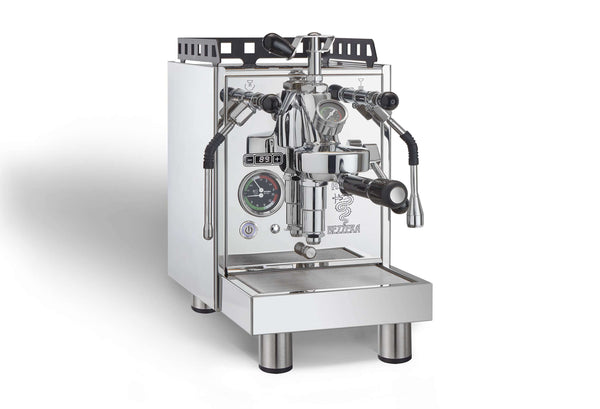
Realistic sweet spot: From around €1,000 for the machine - e.g. a Lelit Mara X or a Bezzera BZ09 - a level of quality begins that will make even ambitious home baristas happy in the long term.

Precision in the portafilter: tamper, leveler & WDT
After grinding, the preparation of the coffee puck determines whether the extraction or channeling is uniform.
The tamper - indispensable
The tamper compacts the ground coffee. Important are
- Exactly the right diameter (usually 58 mm)
- straight contact surface
- comfortable weight
Calibrated tamper can help beginners to develop a feeling for constant pressure.

Leveler & WDT tools - consistency instead of chance
Before tamping, the ground coffee should be evenly distributed. Levelers or WDT tools remove lumps, even out differences in density and significantly reduce channeling.
They are not a luxury, especially for beginners, but a real help for reproducible results.

Almost as important as the grinder: a real espresso scale
If you only really want to call one accessory "mandatory" in addition to the grinder, then it's an espresso scale. Because it turns "pi times thumb" into a reproducible recipe - and that's the difference between a lucky shot and consistency when it comes to espresso.
Why a scale is so important for espresso
Espresso is essentially a ratio: coffee grounds (can) → amount of beverage (yield). Even small differences noticeably change the extraction, body and taste. With a scale, you can check three things that would otherwise quickly "drift away":
- Tin: Do you really have 18.0 g in the strainer - or was it 16.8 g today?
- Yield: Is it 36-40 g espresso - or 55 g "lungo" by mistake?
- Brew ratio: e.g. 18 g in / 38 g out - this is a recipe, not a gut feeling.
Why kitchen scales are unfortunately not enough
Many people start with a kitchen scale - understandably. In practice, however, it is often the wrong helper, because espresso has quick, small changes. Typical problems:
- Resolution too coarse: many kitchen scales only measure in 1 g increments - too inaccurate for espresso.
- Slow response time: the weight "lags behind" - you stop too late.
- No timer / cumbersome: you want to see time and weight at the same time without juggling.
- Too big / impractical: doesn't fit neatly on the drip tray or wobbles with the cup.
What a good espresso scale should be able to do
- 0.1 g accuracy (at least)
- Fast response time
- Timer function or easy-to-read time measurement
- Compact design for the drip tray
- suitable for splash water or heat (espresso is hot and the machine is alive)
Once you work with a scale, something interesting happens: you can really compare recipes. And you can see more quickly whether you need to adjust the grind - or whether the dose/yield just wasn't right today.
Pro tip for beginners: Start with a simple, repeatable recipe, e.g. 18 g in / 36-40 g out and use a suitable brewing time as a guide. From there, you can make targeted fine adjustments - instead of poking around in the fog.

Tidiness & protection: tamper station and work surface
A tamper station or tamper mat not only protects the work surface, but also ensures stability when tamping. A small detail - but one that makes the workflow noticeably more pleasant.

Care & cleanliness - so that taste and technology last a long time
Descaling
Limescale is the silent machine killer. Regular descaling:
- protects boilers and valves
- Maintains temperature stability
- Prevents flavor falsification
Only use suitable descaling agents - do not use household products.
Barista cloths
An often underestimated accessory. Clean steam lance, clean brew group, clean machine - this is not only hygienic, but also relevant to taste. Our barista cloths made from organic cotton

Conclusion: Start consciously - not to the max
Entering the world of portafilter machines doesn't have to be complicated or overpriced. The important thing is that you understand where quality really comes from:
- in the grinder
- in the preparation
- in the consistency
A solid machine, a good grinder and carefully selected accessories will get you further than any oversized all-in-one solution.
And if you have any questions: Ask. Good espresso does not come from perfection - but from understanding and practice.


