Bean profile Mondgold Decaf

EU organic · DE-ÖKO-022
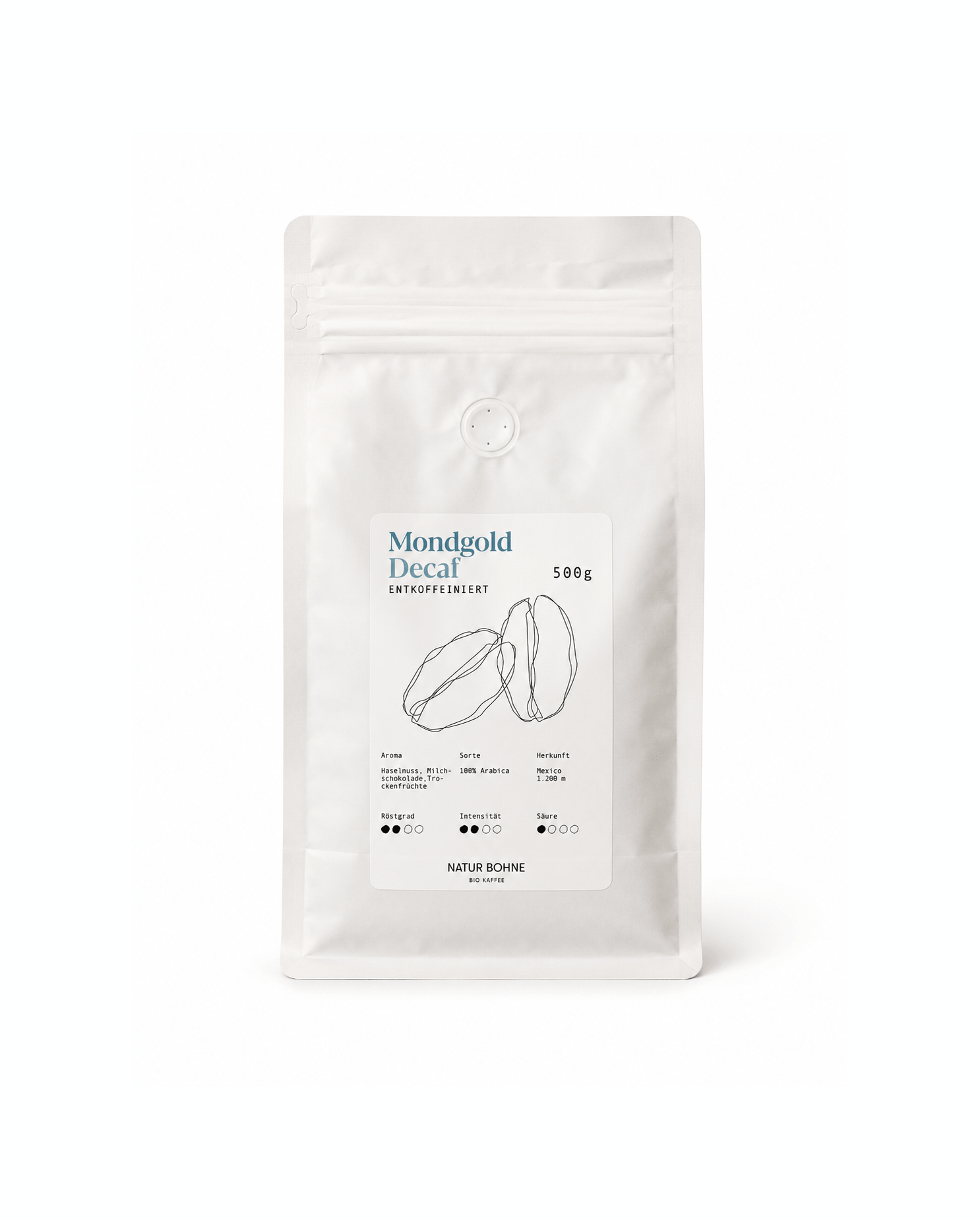
SpeciesArabica
VarietyCatimor, Sarchimor, Roter Caturra
OriginMexico
Altitude1,225 m
ProcessingWashed
HarvestDecember 2025
Roast levelMedium, Omniroast
SCA score82
What makes this coffee special

Sweet, nutty, round

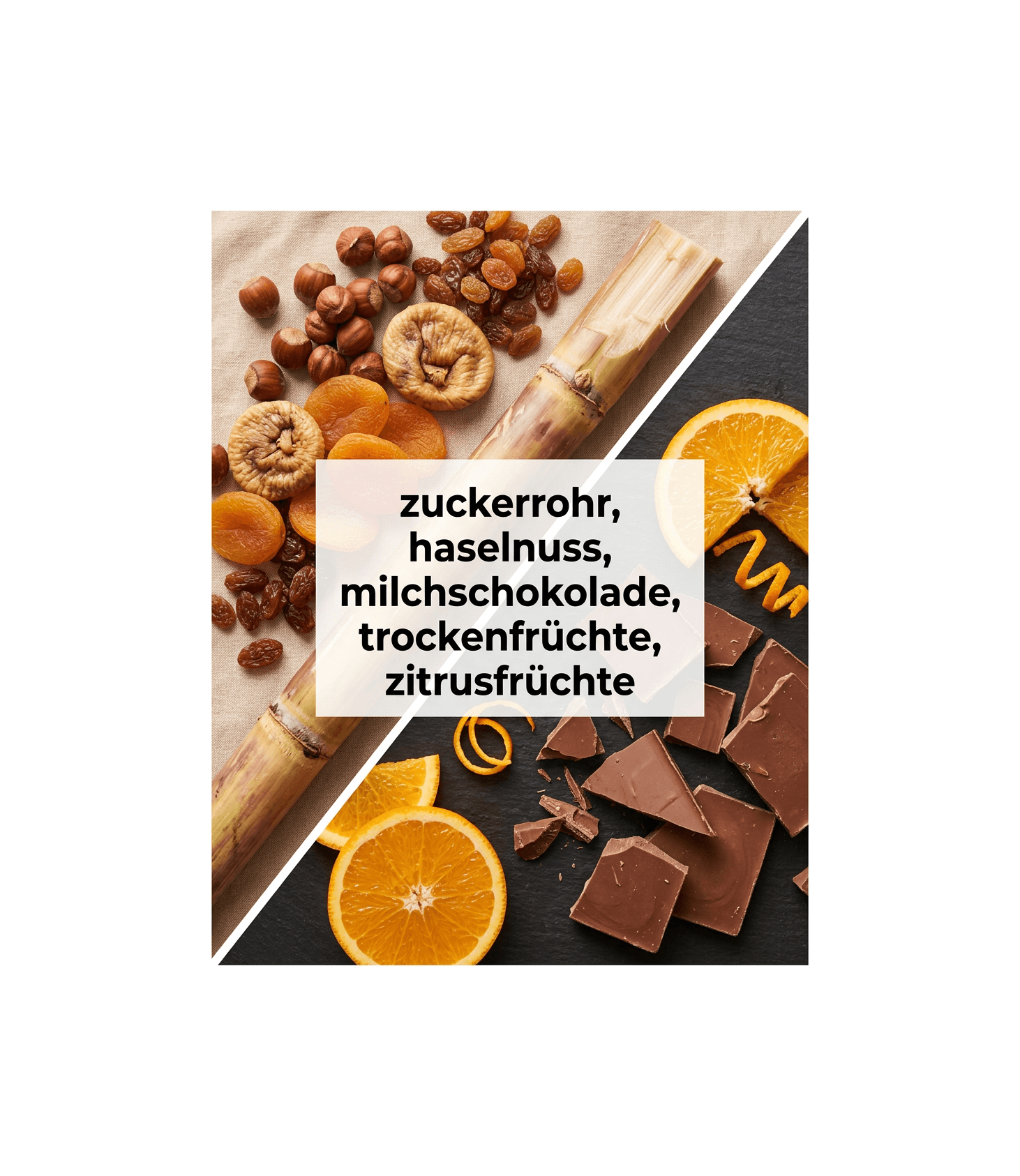
Sugarcane sweetness on the initial sip, followed by hazelnut and milk chocolate, in the finish dried fruit and a light citrus note. The acidity is mild and well integrated, the body soft and round.

SugarcaneHazelnutMilk chocolateDried fruitCitrus fruits

Aromas are natural flavor associations from green coffee and roasting. Nothing is added to the coffee.

Jorge Arreola Nava, Santa Fe, Chiapas (grown in the shade of Inga trees, patio and mechanical drying)

A good fit if you …

  • you want another cup in the evening without it affecting your sleep
  • you want to drink a second or third cup during the day without a caffeine boost
  • you deliberately reduce caffeine but don't want to compromise on taste
  • you want to know who produced a decaf and where it comes from

Probably not if you …

  • you need guaranteed completely caffeine-free coffee
  • you are looking for a strong, dark espresso. Then choose Ätna or Vesuv
  • you expect a decaf to taste exactly like your caffeinated favorite coffee
The people behind the coffee

Who grows your coffee, with names and faces.

We buy in small lots and know the producers whose coffee we roast.

Jorge Arreola Nava, Santa Fe, Chiapas (grown in the shade of Inga trees, patio and mechanical drying)
Jorge Arreola Nava, Santa Fe, Chiapas (grown in the shade of Inga trees, patio and mechanical drying)Jorge Arreola Nava, Santa Fe, Chiapas (grown in the shade of Inga trees, patio and mechanical drying)
Mexico

Jorge Arreola Nava, Santa Fe, Chiapas (grown in the shade of Inga trees, patio and mechanical drying)

Behind Mondgold is not an anonymous green coffee, but the work of Jorge Arreola Nava from the region Motozintla in Chiapas, Mexico. Together with local producers he develops coffees that are convincing in quality and are grown under stable conditions. From this arose the varietal mix of Catimor, Sarchimor and Roter Caturra, adapted to the climatic conditions of the region.

The coffee grows at 1,200 to 1,320 meters in the shade of Inga trees. This cultivation method protects the plants, promotes biodiversity and ensures a slower ripening of the cherries. Harvested in December by hand, processed as washed, dried on patios and mechanically.

Chiapas is one of the most important coffee growing regions of Mexico and borders the Guatemalan region of Huehuetenango. In addition to coffee, cocoa, honey, maize and tropical fruits are grown here. Many farms are family-run and closely linked with the local communities, including indigenous groups such as Tseltal and Tzotzil.

The coffee is decaffeinated in Mexico by Descamex in the patented Mountain Water Process. That means: It is decaffeinated in the country of origin, not only after transport to Europe.

How to get the most out of it

The same bean tastes different with every preparation. Here are the parameters we use to brew it ourselves.

Decaf Espresso

Espresso
Dose
18 g
Yield
36 g
Temperature
92 °C
Time
25 s

Vollautomat

Dose
10–11 g
Yield
25–28 g
Temperature
92–93 °C

Strength medium. Decaffeinated beans grind more easily, so set the grind size one step coarser.

filter coffee

Filterkaffee
Dose
15 g for 250 ml
Water
250 ml
Grind
8 (medium-fine)
Temperature
93–94 °C
Time
2:30–3:00 min

House convention: 250 ml are one cup. Large pot 20 g for 320 ml. Pour-over Hario V60, water quality total hardness 4 °dH, alkalinity 3 °dH.

French Press Espresso

French Press
Dose
40 g
Water
750 ml
Yield
750 ml
Temperature
93 °C
Time
3 min

40 g for 750 ml yields three cups of 250 ml each. After one minute stir the crust, at three minutes press slowly and decant immediately.

Cappuccino

Dose
8–9 g in the single basket
Yield
17–19 g
Milk
135–145 g
Milk temperature
60–65 °C

Cup 150 to 180 ml, 1 to 2 cm foam. Start with cold milk in the jug and do not froth above 70 °C, otherwise the sweetness is lost. For oat drink: use the barista version, the regular one curdles when frothing.

Single origin · Mexico

Where this coffee comes from

We buy in small lots and know the producers whose coffee we roast.

Weltkarte – Herkunft Natural Earth I (wie d3.geoNaturalEarth1), Antarktis entfernt. Punkt = [1000.00 + x·365.58, 569.06 − y·365.58] mit x,y aus der Natural-Earth-Formel (Bogenmaß), siehe weltkarte-README.md. Referenz: 0°,0° → 1000.00,569.06; −42.2°,−20.7° → 770.26,702.34; 75.8°,12.9° → 1417.86,486.10.
Jorge Arreola Nava, Santa Fe, Chiapas (grown in the shade of Inga trees, patio and mechanical drying), Mexico
Mexico

Jorge Arreola Nava, Santa Fe, Chiapas (grown in the shade of Inga trees, patio and mechanical drying)

ArabicaWashed1,225 m
Origin
Mexico
Altitude
1,225 m
Processing
Washed
Harvest
December 2025
Transparency

From green coffee to your bag, every step verifiable.

We have the green coffee analyzed and roast it ourselves. All values here belong to the batch you order.

Vöhringen, Black Forest
Roasted in Vöhringen, Black Forest
More about the roastery →
  1. 1
    Green coffee · intake analysis

    Checked before a bean goes into the roaster

    Each batch comes with lab values from the importer. We present them here unchanged.

    82score
  2. 2
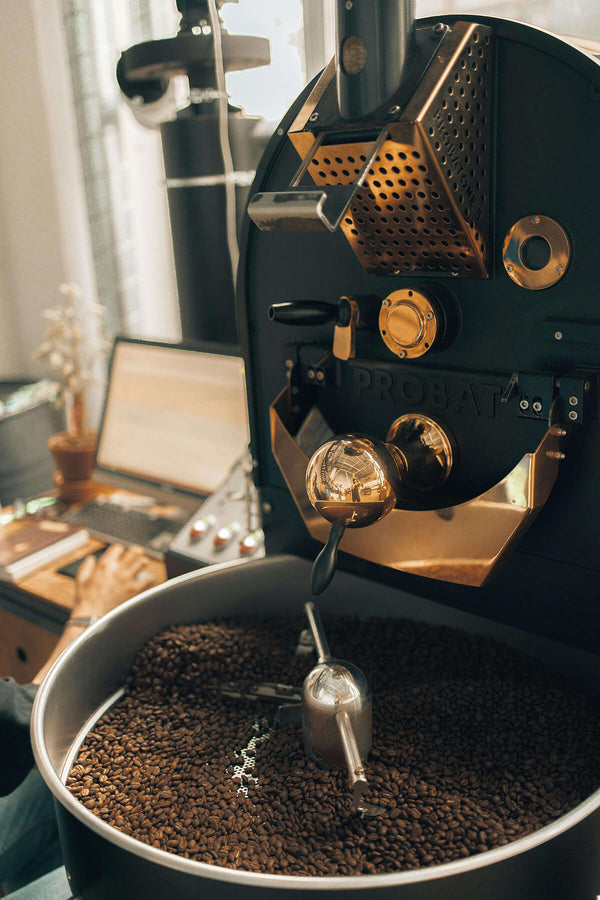
    Roasting · Vöhringen

    Gentle rather than fast

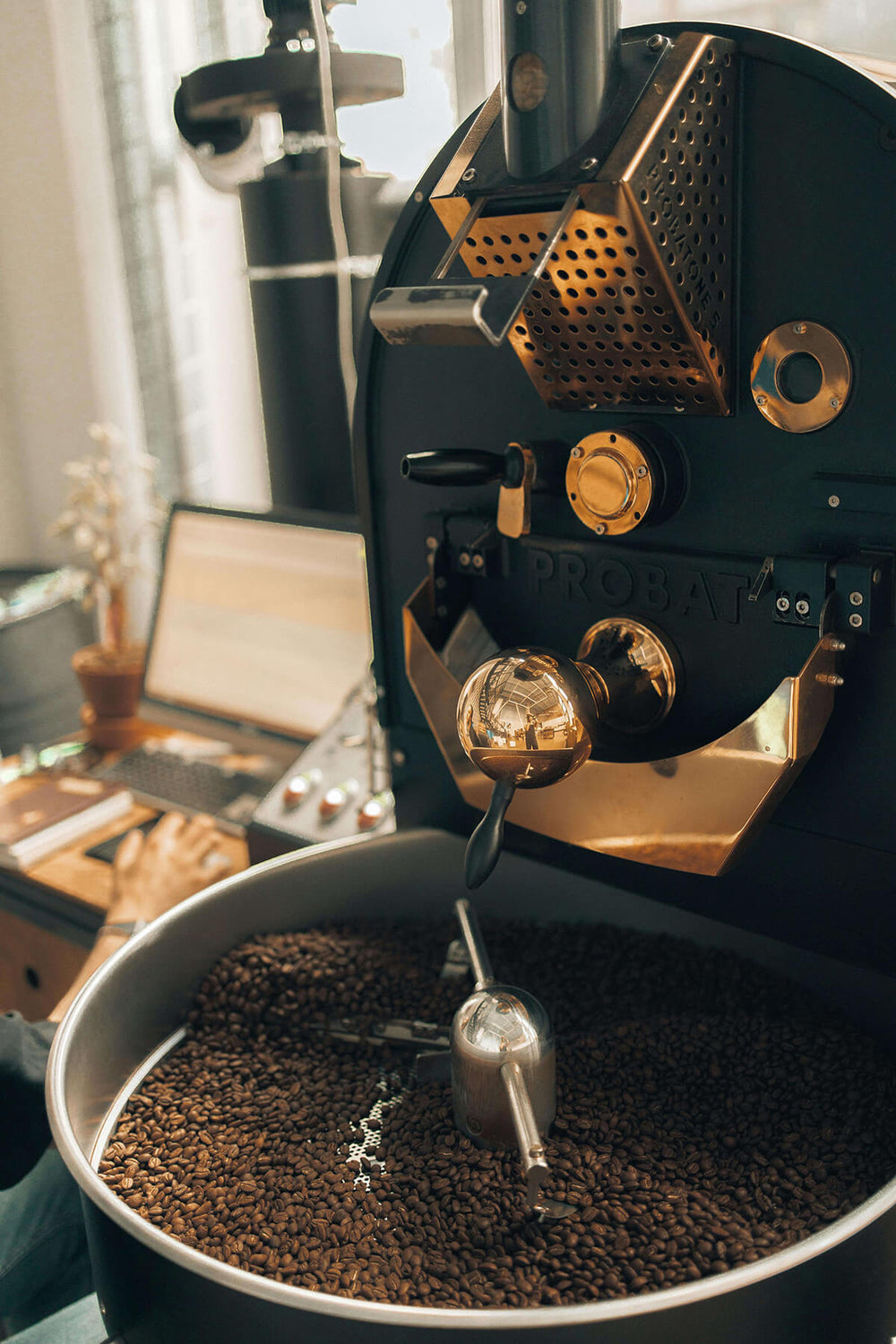
    A roast in which the delicate aromas come to the fore. Large roasteries roast hotter and shorter, which darkens the bean and strips its nuances.

    bis 220 °CRoast temperature
    10 to 15 minutesRoast time
    Medium, OmniroastRoast level
  3. 3
    Freshness · filling

    Your bag is only filled just before shipping

    Until you order, the roast batch is stored sealed in bulk packaging. The roast date is printed on each package.

    10–14 daysResting time, then at its best
    around 3 monthsBest within
    On the bagRoast date
    Before shippingFilling
Customer reviews

No reviews yet

Questions & answers

What customers ask about Mondgold Decaf

If your question is not listed, write to us. We reply personally, usually on the same business day.

Ask your own question →
Verstopft der Mondgold Decaf mein Mahlwerk im Vollautomaten?

Nein, der Mondgold Decaf verstopft das Mahlwerk nicht. Die Bohnen werden im Mountain Water Process entkoffeiniert, wodurch Struktur und Öle weitgehend erhalten bleiben. Sie lassen sich im Vollautomaten wie normaler Kaffee mahlen. Verwende einen mittleren bis mittelfeinen Mahlgrad (etwa Stufe 3–5, je nach Gerät). Reinige das Mahlwerk alle 2–3 Wochen mit Reinigungsgranulat – das gilt für jeden Kaffee.

Schmeckt Mondgold Decaf wirklich nach Kaffee oder merke ich, dass er entkoffeiniert ist?

Du merkst es nicht. Mondgold schmeckt nach Zuckerrohr, Haselnuss und Milchschokolade, mit milder Säure und rundem Körper. Wir nutzen den Mountain Water Process: Die Bohnen werden nur mit reinem Quellwasser aus den Bergen entkoffeiniert, ohne Chemie. Dabei bleiben Geschmacksstoffe und Öle in der Bohne. Das Ergebnis ist ein SCA-Score von 82 Punkten, Spezialitätenkaffee-Niveau. Viele unserer Kunden trinken Mondgold abends oder als zweite Tasse am Tag, ohne auf Aroma zu verzichten.

Für welche Kaffeemaschine eignet sich Mondgold Decaf am besten?

Mondgold Decaf ist ein vielseitiger Omniroast, der sich besonders für Siebträgermaschinen und Vollautomaten eignet. Dank seines ausgewogenen Profils ist er sowohl espressofähig als auch filtertauglich und kann daher auch in Filterkaffeemaschinen, French Press und der Bialetti verwendet werden.

Kann ich den Mondgold Decaf auch in meiner Filterkaffeemaschine verwenden, oder ist das ein reiner Espresso-Kaffee?

Den Mondgold Decaf kannst du genauso gut im Filter zubereiten. Wir rösten ihn als Omniroast, mittlere Röstung, die für Filter, French Press und Vollautomat gleichermaßen funktioniert. Für die Filterkaffeemaschine empfehlen wir mittelfein gemahlen, 93–94 °C Wassertemperatur und etwa 15 g auf 240 ml Wasser. Das ergibt ein rundes, mildes Ergebnis mit Noten von Milchschokolade, Haselnuss und Karamell, ohne Bitterkeit.

Schmeckt der Mondgold Decaf bitter oder sauer? Ich mag keinen Kaffee, der kratzig im Hals ist.

Die Säure ist mild und harmonisch eingebunden, kein Kratzen, kein scharfer Abgang. Das Profil geht eher Richtung Milchschokolade, Waldhonig und getrocknete Feige. Der Röstgrad ist mittel, also weder zu hell-fruchtig noch dunkel-bitter. Schwarz oder mit Milch, beides funktioniert gut.

Klebt der Mondgold Decaf das Mahlwerk meines Vollautomaten nicht zu?

Der Mondgold Decaf ist mittel geröstet, Röstgrad 3 von 5. Mittlere Röstungen haben weniger Ölaustreten als dunkle Röstungen. Das Mahlwerk bleibt sauberer als bei stark öligen Dunkelröstungen. Der Kaffee ist außerdem als Omniroast ausgelegt und explizit für den Vollautomaten freigegeben.

Passt der Mondgold Decaf auch für Cappuccino und Latte Macchiato aus dem Vollautomaten, oder schmeckt er dann zu flach?

Der Mondgold ist explizit für Cappuccino und Latte Macchiato freigegeben. Das Aromaprofil mit Milchschokolade, Karamell und Haselnuss kommt durch Milch gut durch, genau die Noten, die im Milchgetränk nicht verschwinden. Mittlere Röstung, 100 % Arabica aus Mexiko: das Ergebnis ist rund und vollmundig, nicht flach.

Für welche Kaffeemaschinen kann ich den Mondgold Decaf verwenden?

Mondgold Decaf ist als Omniroast geröstet und eignet sich besonders für Vollautomaten. Mahle die Bohnen am besten frisch, um das volle Aroma zu genießen.

How fresh is the coffee when it arrives?

We roast in Vöhringen and only fill your bag immediately before shipping. Until then the roast batch is stored sealed in bulk packaging. The roast date is printed on every package. After 10 to 14 days of resting the sweetness and body are just right, after that the coffee remains aromatic for about four months.

Whole bean or ground?

Both. In addition to whole bean we grind on request for portafilter (fine), drip coffee maker, moka pot or French Press (coarse). Freshly ground tastes best, ground coffee loses aroma faster.

What package sizes are available?

250 g and 500 g, most varieties also as 1 kg. The larger the package, the cheaper the price per kilo. We display the price per kilo directly at the size selection.

Is the coffee really organic?

Yes. All our coffees are EU organic certified, Naturgold and Naturharmonie are additionally Demeter certified. The responsible organic control body is shown on each product page in the bean profile, together with the note non-EU agriculture.

Can I get the coffee on a subscription?

Yes. With a subscription you save 10 % compared to a single order. You set delivery frequency and quantity directly at purchase.

Packaging

Organic packaging made from renewable raw materials

Bio-based PLA film made from sugarcane or corn starch instead of petroleum, FSC® paper, manufactured in the EU. Protects against UV, oxygen and moisture, and is resealable after opening.

OK biobasedFSC® paperMade in EU
  • Degassing valve Lets CO₂ out, no oxygen in.
  • Resealable Hygienically sealed once, then resealable with a zipper.
  • Light protection Laboratory tested, even for high UV protection requirements.
  • Roast date Is printed on every package. Filled only before shipping.

Or write to us

Subject: Mondgold Decaf, decaffeinated organic coffee from Chiapas, we add that automatically

No newsletter. We reply personally.