








It’s the question that’s been popping up in every coffee forum for years and has never been clearly answered: Does choosing organic espresso mean compromising on flavor? Do you buy the bean with the organic label because it’s good, or because it makes you feel better?
The honest answer is more uncomfortable than either side would like. It’s neither “organic tastes better” nor “organic is just marketing.” It’s this: The farming method alone doesn’t determine the taste of the cup. But the most comprehensive German consumer test of espresso beans nevertheless reached a clear conclusion—and it favored the organic variety over the conventional one.
What the consumer test actually revealed
ÖKO-TEST examined 22 espresso coffees made from whole beans, comparing conventional and organic products side by side. Four sensory evaluators specially trained in coffee assessed aroma, taste, balance, and crema. At the same time, the samples were sent to the lab to test for acrylamide and furan—byproducts of roasting—as well as ochratoxin A, a mycotoxin that develops after harvest. The suppliers were also questioned about production conditions in the growing countries.
The result: Of 22 roasts, only five were recommended. Four failed completely. The rest fell into the middle range.
The key point regarding our initial question: Not a single conventional bean was among the recommended products. The conventional roasts ranged from mediocre to poor, while the private-label brands from discounters and supermarkets mostly fell into the middle range.
And now the part most people leave out
This result does not imply that organic farming makes for a better cup of coffee. The overall rating was based on several factors: sensory evaluation, contaminants, and production conditions. The organic products didn’t win because they tasted significantly better. In terms of sensory evaluation, almost all samples performed well. They won because they scored higher in every category beyond taste.
Here’s an example of how price and quality are two different things: The most expensive product in the entire test was a conventional dark roast from a well-known international chain—and, of all things, it was the only one that failed the sensory evaluation. The testers described it as noticeably bitter, burnt, and harsh, with a crema that was too thin.
One caveat: The test dates back to 2019. It is the most reliable publicly available data set on this issue in the German market, but it is no longer up to date.
The question the test didn’t even ask
And this is where it gets interesting. If you look at which products were actually included in the test, something stands out: They were all private-label brands, supermarket products, and major organic brands from the natural foods sector. On both sides—conventional and organic—the products tested were mass-produced items.

Not a single specialty roaster was included.
So the test answers a very specific question: Which beans do you choose when you’re standing in the supermarket? The second factor—which is at least as important for the cup of coffee—wasn’t addressed at all. What actually happens between the green coffee beans and the bag?
How the beans are roasted matters more than the label
Industrial roasting processes use very high temperatures and very short times. Beans are roasted in just a few minutes, often using hot-air methods, in batches significantly larger than what a specialty roaster would roast in a week. This isn’t sloppiness, but economics: time is the most expensive factor in roasting.
The cost of this is reflected in the cup. With very rapid roasting, the interior of the bean does not develop at the same rate as its surface. The result is roasted flavors that overwhelm everything else: strong, dark, but flat. The origin profile—the fruitiness from Ethiopia, the nuttiness from Peru, the caramel sweetness from Brazil—disappears beneath the roast.
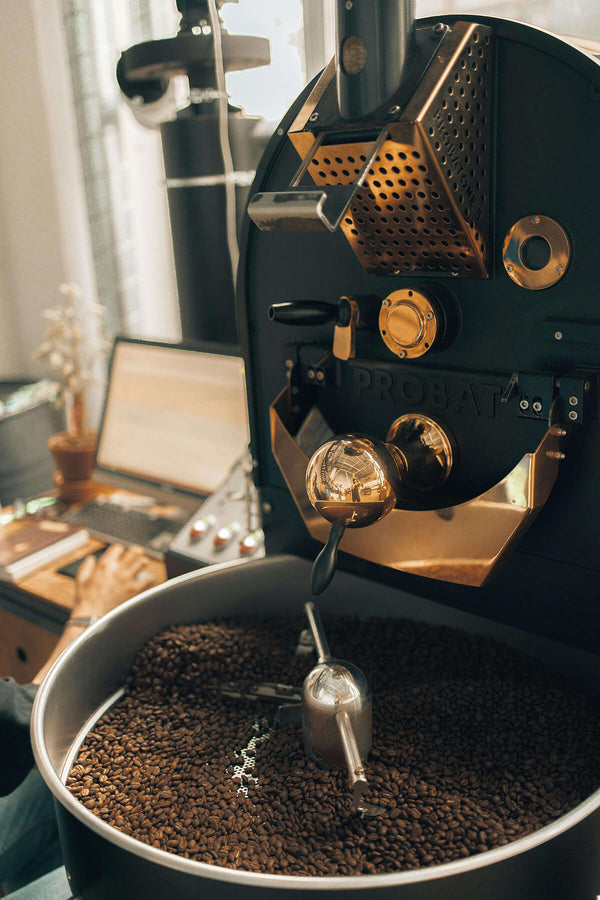
We roast our beans at around 210 degrees Celsius for 13 to 16 minutes in the drum. Not out of nostalgia, but because that’s the time a bean needs to develop evenly. Each origin gets its own roast profile: when and how quickly the temperature rises, where the development phase ends after the first crack, and how long the post-crack phase lasts. We determine this profile anew for each batch through test roasts and tastings until we capture the flavor profile inherent in the bean.

That’s why a Peruvian espresso from us tastes different from a Brazilian one. With very quickly roasted mass-produced coffee, they taste more similar than they should.
What Else Goes Into It
Three things you won’t see on the package but that still end up in your cup:
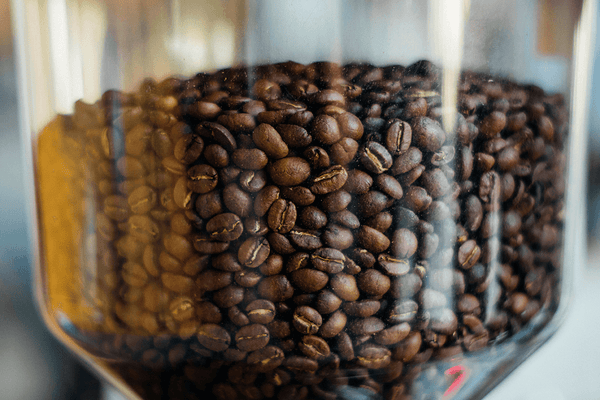
Bean selection. We make sure that whole, uniform beans go into the bag and that there are as few broken pieces as possible. Broken pieces roast faster than whole beans and burn while the rest are still developing their flavor. In the cup, you’ll notice this as a bitter note that doesn’t belong there.
The origin and the people behind it. We work with cooperatives and small-scale farmers and disclose where each batch comes from: country, region, growing altitude, and often even the specific farm. Anyone who simply writes “100% Arabica” on the package either doesn’t have this information or doesn’t want to share it.
The time of packaging. Our roasted beans are stored in large, sealed containers and aren’t packaged until an individual order is placed. So we don’t produce pallets in advance that then sit in a warehouse for months. That’s why, when you buy from us, you get a roast date that actually means something.
The reverse calculation: What’s left when you pay 14.49 euros for a kilo?
Now let’s get specific. Let’s take a typical offer, like the ones you’ll find on any marketplace: one kilogram of whole beans, certified sustainable, for 14.49 euros. Sounds like a fair price for certified goods. Let’s work backward to see how much of that actually goes toward the green coffee.
| Item | Amount | Remaining |
|---|---|---|
| Gross sales price, 1 kg | €14.49 | €14.49 |
| Value-added tax, 7% in Germany on roasted coffee |
€0.95 | 13.54 € |
| Coffee tax, 2.19 € per kg of roasted coffee | 2.19 | 11.35 € |
| Retail markup, assumed 30% | 3.41 € | 7.94 |
| Packaging, valve bag, label | about 1.00 € | €6.94 |
| Roasting, energy, handling, logistics, import | €2.00 to €3.50 | 3.44 to 4.94 € |
So that leaves roughly 3.44 to 4.94 euros for the green coffee. And now comes the factor that almost everyone forgets: roasting loss. During roasting, water evaporates, and the bean loses about 18 percent of its weight. So, for one kilogram of finished roasted coffee, you need about 1.2 kilograms of green coffee.
Converted to the price per kilogram of green coffee, that leaves about 2.80 to 4.00 euros.
By way of comparison: In 2026, Arabica was trading on the world market at around 273 to 297 U.S. cents per pound. That corresponds to roughly 5.50 to 6.00 euros per kilogram of green coffee. Robusta was significantly lower.
So the math doesn’t add up with freshly purchased Arabica. It only works if at least one of these conditions is met: a high proportion of Robusta, lower-grade coffee, or contracts that were concluded before the price increase.
What This Means for Cultivation
At this price level, a certain type of production is simply not financially viable. What becomes necessary instead:
- Mechanical harvesting instead of selective hand-picking. The machine takes everything hanging on the branch. Unripe green cherries end up in the same bag as ripe red ones. Unripe cherries introduce astringent, grassy notes into the cup that no amount of roasting can later fix.
- Conventional pesticide use and mineral fertilization. At this price level, yield per hectare is the decisive factor.
- Large roasting batches with short roasting times. Energy and time per kilogram must be kept to a minimum.
- Long storage periods. Product is produced and packaged for stock, not to order.

And the producer? They’re at the beginning of the chain and have the weakest bargaining position. What they end up with is whatever’s left over after everyone else has taken their share.
To be fair, it’s important to note: This calculation is a plausibility check, not a bank statement. Trade margins fluctuate, roasteries secure green coffee through long-term contracts, and packaging costs decrease with volume. But the order of magnitude is correct, and it shows what the price difference is really about.
A seal on a package like this tells you that a certain minimum standard has been verified. It doesn’t tell you that the beans were selectively harvested, sorted by variety, and roasted with care. There’s simply no money left in this calculation for any of that.
The Opposing View
There is a serious counterargument in the specialty coffee scene, and it’s worth listening to: Organic farming is better for the soil and resources, but has nothing to do with flavor or cup quality. There’s also a practical argument: Many small roasteries and producer cooperatives operate according to organic principles without being able to afford certification. Just because there’s no seal on the package doesn’t mean the production process wasn’t done properly.
Both points are valid. That’s why the useful conclusion isn’t “buy organic, and it’ll taste better,” but rather: The certification label clarifies how the coffee was grown. The roaster clarifies what became of it. You need both.

What an organic label covers—and what it doesn’t
The most common confusion on the shelf: organic and fair trade are thought of as a single package. They are not.
EU organic law regulates organic production, certification, labeling, and inspection. It is environmental law, not social law. An EU organic logo on the package tells you nothing reliable about minimum prices, advance payments, or working conditions on the farm. Conversely, a Fairtrade label by itself says nothing about which pesticides were used during cultivation.
The ÖKO-TEST revealed exactly that: Only two of the coffees tested could simultaneously provide evidence of their supply chain, minimum price, potential advance financing, minimum social standards, and a ban on highly toxic pesticides. Two out of 22.
If both of these factors are important to you, you need to see both on the package—or choose a roaster that discloses its supply chain instead of just printing logos. We’ve broken down exactly how to interpret these labels in detail in our honest guide to organic beans and sustainable coffee.
The Right Organic Bean for Your Machine
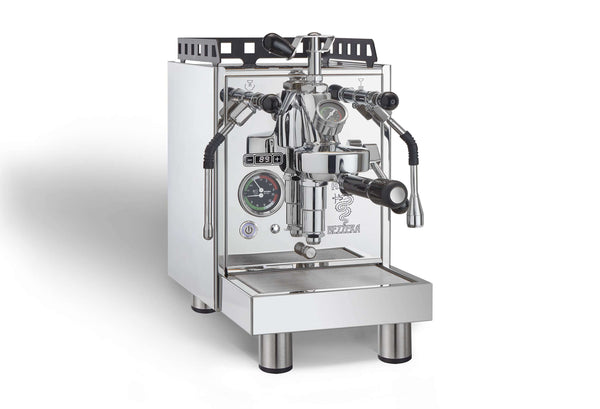
Here, the fundamental question becomes a purchasing decision. After all, the most important characteristic of an espresso bean isn’t its certification, but its roast level—and that must be compatible with your machine.
| Criterion | Fully Automatic Coffee Machine | Portafilter | Filter or manual brew |
|---|---|---|---|
| Recommended Roast Level | Medium to medium-dark | Medium to dark; light espresso roasts are also possible | Light to medium-light |
| Bean surface | Matte to slightly silky, never heavily oily | A slight oily film is not a concern | Matte |
| Reason | Oil causes the hopper, bean chute, and grinder to stick, increasing the load on the motor | The grinder is more robust and easier to clean | Roasting oils play hardly any role in extraction |
| A flavor profile that delivers consistent results | Nut, caramel, milk chocolate, almond | From chocolatey to fruity, depending on the recipe and settings | Floral, fruity, berry, citrus |
| Light single-origin coffees | Generally unsuitable, as slight under-extraction makes the cup thin and sour | Suitable with precise settings | Core discipline |
| Blend or single origin | Blends are more forgiving | Both, depending on the goal | Single Origin |
The practical test for owners of fully automatic machines is simple: Open the bag and touch the beans. If your fingers get greasy, that bean belongs in a portafilter, not in the machine. Over time, heavily oily beans will not only cost you flavor due to oxidized fats, but also grinders, gaskets, and service visits.
And here’s another misconception: The color of the bean isn’t an organic characteristic. An organic coffee can be light or dark roast. If you’re using a light organic filter roast in a fully automatic machine and find it sour, you don’t have an organic problem—you have a roast level problem.
Our Recommendations by Application
To keep this from being just theory: These are the beans from our selection that we’d recommend for each situation. All are organic or Demeter-certified, all have an SCA score, and all are roasted in small batches.
| If you... | Recommendation | Profile | SCA | Price |
|---|---|---|---|---|
| have a fully automatic machine | Bergkraft | Caramel, chocolate, almond. Specifically developed for fully automatic coffee machines, mild acidity | 84 | €12.90 |
| If you’re looking for the best espresso from a portafilter | Andean Pearl | Mild, nutty, almond, caramel, citrus. Single-origin Peru, Fairtrade, our bestseller | 87 | €12.90 |
| if you like it bold and low in acidity | Natural Gold | Nutty, chocolate, caramel. Demeter, Brazil, specifically low in acidity | 84 | €14.90 |
| mainly drink milk-based beverages | Mount Everest | Chocolate, nougat, caramel. A full-bodied Signature Blend that holds its own against milk | 84 | €11.90 |
| If you want one bean for everything | House Blend No. 1 | Dark chocolate, nougat, citrus. Suitable for everything from espresso to drip coffee | 85 | €13.90 |
| If you prefer a classic Italian style | Etna | Dark chocolate, nougat, hazelnut, earthy depth | 82 | €11.90 |
| if you want an espresso in the evening | Moon Gold Decaf | Sugar cane, hazelnut, milk chocolate. Decaffeinated without chemical solvents | 82 | €13.90 |
| Brewing filter coffee | Sonnental | Almond, nutty, caramel, citrus. Single Origin Peru, Fairtrade | 84 | €13.90 |
If you’re unsure: Start with 250 grams, not a kilo. A bean you don’t like is too expensive no matter the size.
How much organic espresso beans cost per cup
In the ÖKO-TEST, conventional espresso beans ranged from 6.99 to 23.96 euros per kilogram, while organic products ranged from 9.99 to 21.99 euros. What’s remarkable is that the price ranges overlap almost completely. The most expensive product in the test was conventional. The blanket “organic premium” that many people assume didn’t show up on the shelves.
Since then, the entire market has shifted upward, regardless of whether the product is organic. The global market price for green coffee has risen sharply due to extreme weather conditions in Brazil and Vietnam. You won’t notice yet on the shelves that exchange prices have recently fallen again: roasteries secure green coffee through supply contracts months in advance, so any price movement takes time to filter down.
More interesting than the price per kilogram is the price per cup:
| Price per kilogram | Cost per double espresso (18 g) | Cost for 2 cups a day per month |
|---|---|---|
| 10.00 euros/kg | 0.18 euros | 10.80 euros |
| 16.00 euros/kg | 0.29 Euro | 17.28 euros |
| 22.00 euros/kg | 0.40 euros | 23.76 euros |
| 48.00 euros/kg | 0.86 euros | 51.84 euros |
So, if you drink two espressos a day, the jump from discount coffee beans to freshly roasted specialty coffee will cost you a manageable two-digit amount per month. By comparison, two cappuccinos at a café in many cities cost more than a whole week’s worth of espresso at home.

Where you shop matters more than you think
Supermarket, drugstore, farmers’ market, or roastery: This matters more for your cup of coffee than the brand you choose. The reason is freshness, and you can tell by a single detail.
Prepackaged foods in the EU must carry a best-by date. A roast date, on the other hand, isn’t required anywhere. That’s exactly why it’s so telling: whoever prints it has nothing to hide. Someone who only lists a best-by date of 24 months isn’t telling you whether the bean is two weeks or fourteen months old.
For espresso, this is no minor detail. Freshly roasted beans release CO₂ for days. In the first few days after roasting, this leads to an erratic flow rate in the portafilter, channeling, and results that are difficult to reproduce. Conversely, the aromas fade over time, the roast oils oxidize, and the extraction becomes flat. The practical window is considered to be a few days after roasting up to about six to eight weeks afterward.
What to look for when buying:
- Roast date printed on the package, not just a best-by date
- An intact aroma valve on the bag that allows CO₂ to escape without letting oxygen in
- Undamaged seal
- Specific origin information rather than just “100% Arabica”
- Information on variety, processing method, and altitude if the label says “Specialty”
- Uniform, whole beans without an unusually high number of broken pieces
- Appropriate package size: better to buy two 250-gram packages one after the other than one kilo that sits open for three months
Organic and decaffeinated: Here, the seal is a technical criterion
A special case where “organic” directly impacts the processing method. Caffeine can be extracted from the beans in several ways: using chemical solvents such as dichloromethane or ethyl acetate, using supercritical CO₂, or using water-based methods such as the Swiss Water or Mountain Water processes.
For certified organic products, the use of chemical solvents is prohibited under EU organic regulations. In practice, this means that organic decaf is produced using the CO₂ method or a water-based method. Since the decaffeination method is rarely listed on the packaging at all, the organic logo is often the only reliable information you’ll find.
You can find our decaffeinated beans under the names Mondgold Decaf and Nachtgold Decaf.


How to Find Your Perfect Bean in Four Steps
- Start with the machine. Fully automatic machines call for a medium to medium-dark roast and a dry surface. A portafilter lets you explore the full range.
- Choose a flavor profile. Nutty, chocolate, and caramel for bold and low-acidity. Berry, citrus, and floral for light and lively. Both are available in organic.
- Check the roast date and origin. No roast date means no indication of freshness. No origin information means no indication of the bean itself.
- Start small. 250 grams—try it out, then reorder.
Here you’ll find organic espresso beans, a selection for the portafilter, roasts suited for fully automatic machines, and decaffeinated organic beans. Learn more about our work under “About Naturbohne.”


