

Buying Guide & Comparison · Updated May 2026
Bezzera Portafilter Machines 2026: Which One Is Right for You? (Buying Guide, Comparison & All Models, Including the Nini Series and Fast Heat)
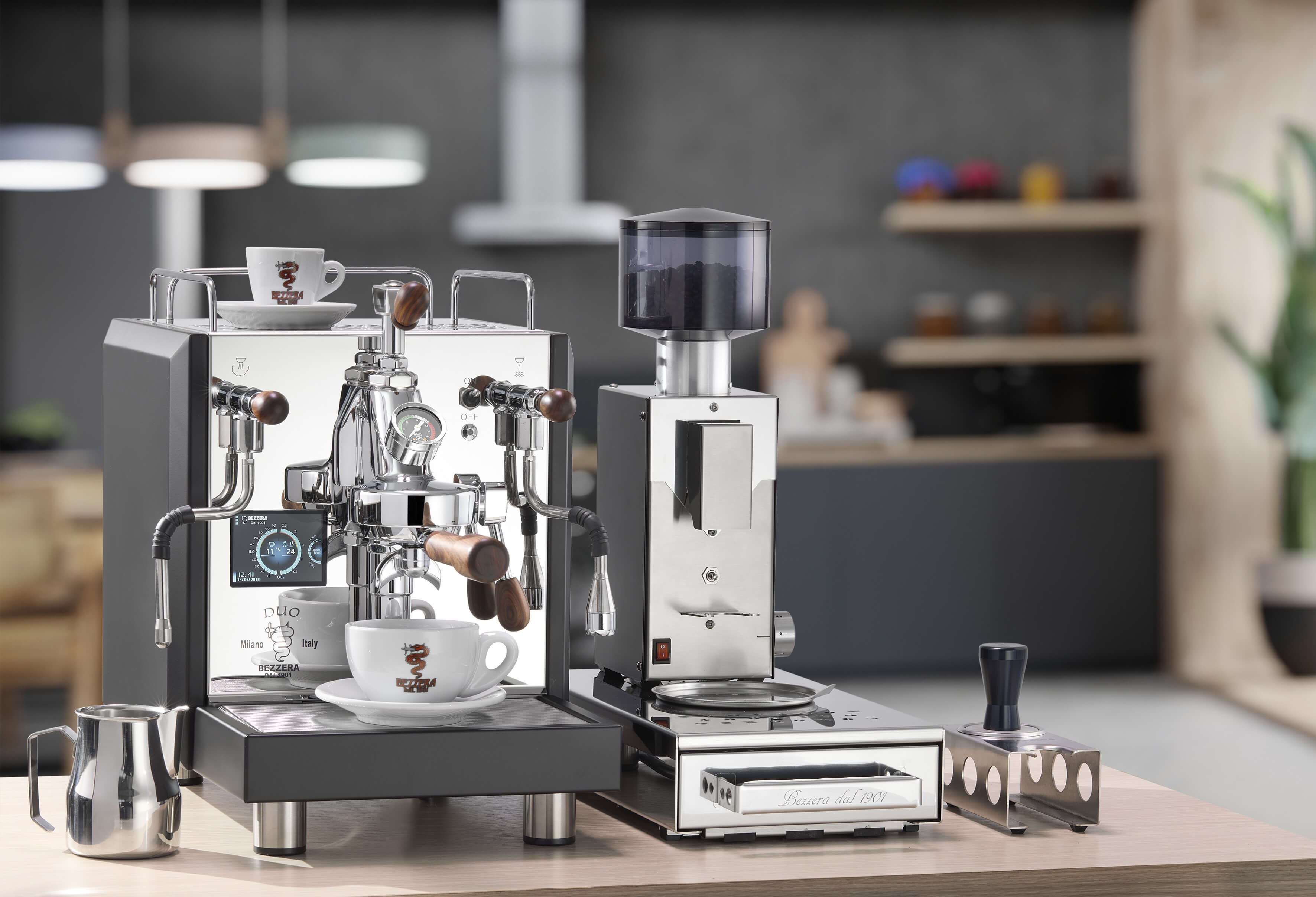
Bezzera is one of Italy’s most traditional espresso machine manufacturers—known for robust engineering, excellent value for money, and (depending on the model) very short heat-up times thanks to Fast Heat technology. In this updated 2026 buying guide, you’ll find a quick decision-making guide, all model recommendations—including the new Nini series—as well as answers to common questions, with direct links to the corresponding machines.
Go directly to the Bezzera collection: View all Bezzera portafilter machines
Quick selection: Find the right Bezzera in 30 seconds
I want a compact entry-level model (espresso focus)
Then the new Nini series is ideal: a compact dual-circuit machine with a heat exchanger, classic controls, and a small footprint. Choose based on ease of use and PID preference.
- Bezzera Nini PM (manual, entry-level)
- Bezzera Nini DE (with electronic dosing)
- Bezzera Nini PID PM (PID + manual)
- Bezzera Nini PID DE (PID + dosing)
I drink almost exclusively espresso (without milk)
Single-circuit or dual-circuit machines with PID are ideal for maximum reproducibility and temperature control. If you want to upgrade later: Flow Control can be retrofitted to E61 brew groups.
- Bezzera Luce (classic, compact)
- Bezzera Luce PID (more control over temperature)
- Bezzera Luce S PID Fast Heating Inox (E61 + Fast Heat)
I often make cappuccino & latte
Dual-circuit or dual-boiler machines allow for simultaneous brewing and milk frothing. For added convenience, DE versions with volumetric dosing are worth considering.
I want to be ready to go quickly (Fast Heat)
Fast Heat models feature an additional heated E61 brew group, making them up to 20 minutes faster to prepare than standard E61 machines. Ideal for spontaneous espressos in the morning or at the office.
I want technology & features (display, profiles, more control)
Then the “Top” models are exciting—with more control, more convenience, and, depending on the version, volumetric dosing.
Bezzera Nini Series: The New Compact Entry-Level Model
The Bezzera Nini is a new addition to the lineup in 2026 as a compact dual-circuit machine and is positioned, both in terms of price and technology, as the smaller, space-saving sibling of the Luce. At just 25 cm wide and featuring a 1.5-liter copper heat exchanger, it fits even in small kitchens without sacrificing the typical Bezzera workflow experience.
Key features at a glance:
- Design: Dual-circuit with 1.5-liter copper boiler (heat exchanger)
- Group head: Bezzera BZ group head (58 mm portafilter), mechanical pre-infusion
- Water tank: 3 L, rear-mounted, vibration pump
- Dimensions: 365 × 250 × 448 mm (H × W × D), 20 kg
- Power consumption: 1,100–1,300 W
- Cup warmer: passive · Steam power: medium · Standby: not available · App control: not available
Four variants differ in two aspects: operating mode (PM = manual vs. DE = electronic dosing with volumetric programming) and temperature control (with or without PID, including shot timer).
Comparison table: Which Nini is right for you?
| Feature | Nini PM | Nini DE | Nini PID PM | Nini PID DE |
|---|---|---|---|---|
| Operation | Manual (lever/button) | volumetric (electronic metering) | manual (lever/button) | volumetric (electronic dosing) |
| PID control | no | no | yes (brewing boiler) | yes (brewing boiler) |
| Shot timer | no | no | yes | yes |
| Flow Control | Not provided | Not provided | optional | optional |
| Ideal for | Beginners, purists, those on a tight budget | Convenience-oriented users, households with multiple users | Home baristas with high temperature standards & a focus on workflow | Discerning home baristas seeking convenience |
| Price range (MSRP DACH) | Affordable | moderate | medium | High |
Quick recommendation: If you already use a scale and timer and want to be in control, the Nini PID PM is the sweet spot. If multiple people in your household use different dosages or you want consistent cups without thinking, the Nini PID DE is worth it. The versions without PID are the choice if you’re on a tight budget or want to experiment with bean profiles without using additional controls.
Fast Heat & Fast Heating: What does this mean technically—and for whom is the extra cost worth it?
Classic E61 brew groups consist of a solid brass block that is thermally flushed by the boiler water, bringing it up to brewing temperature. This is robust and temperature-stable, but—depending on the machine and ambient temperature—it typically takes 20 to 30 minutes for the group to be truly ready for use.
Bezzera’s Fast Heat or Fast Heating technology integrates an additional heating element directly into the E61 brew group. This allows the group to be heated actively and independently of the boiler.
Concrete benefit in everyday use
- Reduced warm-up time: up to about 20 minutes compared to a standard E61
- Better responsiveness: the group “drops off” less when you start brewing again after a long break
- Same stability: the thermal mass of the E61 group is preserved—you lose nothing
Who benefits from the extra cost?
| Pros of Fast Heat | Arguments against Fast Heat |
|---|---|
| You spontaneously make an espresso in the morning without a 30-minute warm-up | You turn the machine on early anyway and then use it for an extended period |
| Office or practice setup with irregular brewing times | You prefer pure standard E61 characteristics without active group heating |
| More than 5–10 brews per day, spread throughout the day | You want the most affordable model in the respective line |
Available in two models:
- Bezzera Luce S PID Fast Heating Inox – compact dual-circuit machine with E61, vibration pump, 4-liter tank
- Bezzera Sole Top PID Fast Heat Inox – semi-professional with rotary pump, 4-liter tank, quiet operation
MN, DE, and PM: What do the Bezzera abbreviations mean?
Bezzera uses a series of abbreviations that may seem confusing at first glance—but follow a clear logic:
| Abbreviation | Meaning | What does this mean in practice? |
|---|---|---|
| MN | Manuale (manual version) | You start and stop the brew yourself – barista workflow. |
| PM | Manual control panel | Used in the Nini series – manual extraction via button, without volume programming. |
| DE | Dosatura Elettronica (electronic dosing) | Programmable dispensing buttons for volumetric dosing – convenience and consistency. |
| PID | Proportional-Integral-Differential | Electronic temperature control of the brew boiler – more consistent brewing temperature. |
| Top | Top-of-the-line features | Indicates the higher-quality features within a model line. |
| Fast Heat / Fast Heating | Heated E61 brew group | Additional heating element in the E61 group – significantly shorter warm-up time. |
In short: MN/PM = manual, DE = volumetric, PID = precise temperature, Fast Heat = ready for use quickly.
PID & Flow Control: When is it worth it?
PID (Temperature Control)
PID is particularly worthwhile if you frequently change beans, drink light roasts, or want reproducible shots. With “PID” models, you typically have finer control over the brew temperature and usually also an integrated shot timer.
Flow Control (Flow/Pressure Control)
Important: Flow Control can generally be retrofitted to all E61 brew groups —ideal if you want to experiment with pre-infusion and pressure profiling later on without immediately purchasing a new machine setup. The Bezzera Flow Control Kit is specifically designed for E61 brew groups and intended as a retrofit.
Note on the Nini series: The Nini uses the Bezzera BZ brew group, not E61. Flow Control in the classic E61 sense is optional here for the PID versions; the standard E61 Flow Control Kit does not fit.
MN/PM vs. DE: Which is better?
MN/PM = manual, DE = volumetric. It is less a question of quality and more a matter of style.
| Question | MN / PM (manual) | DE (volumetric) |
|---|---|---|
| Operation | You start and stop the dispensing yourself. | You use programmable dispensing buttons (quantity / volume). |
| Who is it for? | Purists, those willing to learn, those who enjoy experimenting. | Everyday use, multiple users in the household, consistency at the touch of a button. |
| Result | Perfect if you’re already using a scale and timer. | Very convenient—scales and fine-tuning remain useful. |
All Bezzera 2026 models at Naturbohne at a glance
Entry-level & Espresso-focused
Bezzera Nini PM
For whom: Beginners and purists on a tight budget with limited counter space.
Why: Compact dual-circuit machine, BZ group, manual extraction—an authentic Bezzera experience without frills.
Bezzera Nini DE
For whom: Comfort-oriented users seeking reproducible shots without stopping.
Why: Volumetric dosing electronics in the most compact Bezzera format – ideal for multi-person households.
Bezzera Nini PID PM
For whom: Home baristas who want to control the temperature and brew manually.
Why: PID + shot timer + manual workflow – the “sweet spot” of the Nini series for ambitious users.
Bezzera Nini PID DE
For whom: Discerning home baristas who want convenience.
Why: PID + shot timer + electronic dosing – the top-of-the-line model in the Nini series.
Bezzera Luce
For whom: Espresso-focused, classic setup, intuitive operation.
Why: A solid foundation without overkill – the established entry-level model with Bezzera DNA.
Bezzera Luce PID
For whom: Espresso purists who want precise temperature control.
Why: PID = more consistency, easier bean changes, less guesswork.
Bezzera Luce S PID Fast Heating Inox
For whom: Home baristas who want to combine E61 character with a short heat-up time.
Why: Heated E61 brew group – ready to brew up to 20 minutes faster than a standard E61.
Milk Beverages & All-Rounders
Bezzera Aria (Classic / Top)
For whom: Espresso and milk-based drinks, classic Italian workflow feel.
Why: A good balance of performance, everyday usability, and value – especially for cappuccino and latte at home.
Bezzera Aria S MN
For whom: Fans of manual operation who want the Aria line in a clear MN configuration.
Why: MN = manual, ideal for users who already work with a scale and timer.
Bezzera Aria Top MN PID
For whom: Milk-based drinks and more control, but deliberately “hands-on” (MN).
Why: PID + top-of-the-line features – for users who want control without needing full automatic functionality.
Discerning home baristas & top-of-the-line features
Bezzera Sole Top PID MN
For whom: Discerning home baristas focused on stability and reproducibility.
Why: Top-of-the-line features + PID, MN for the direct barista workflow.
Bezzera Sole Top PID Fast Heat Inox
For whom: Discerning home baristas and offices with irregular brewing times.
Why: Sole Top-level performance plus a heated E61 brew group and rotary pump—fast, quiet, and stable.
Bezzera Matrix Top MN
For whom: Fans of features and design who want a “high-end home” experience.
Why: Matrix stands for modern control and feature logic—ideal if you like fine-tuning.
FAQ: Common Questions Before Purchasing
What distinguishes the Bezzera Nini from the Luce?
The Nini is more compact (250 mm wide vs. approx. 305 mm for the Luce), uses the Bezzera BZ brew group instead of the E61, and is priced lower. The Luce—especially the Luce S PID Fast Heating—relies on the classic E61 brew group with greater thermal mass. If you want maximum space savings and a focus on espresso, go for the Nini. If you want to use the E61 ecosystem (flow control, standard replacement parts) in the long term, go for the Luce.
What exactly does Fast Heat offer?
Fast Heat reduces the warm-up time by up to about 20 minutes compared to a standard E61 brew group. Instead of a 20–30-minute warm-up, the machine is ready for use in significantly less time because an additional heating element is located directly in the E61 brew group. Temperature stability is maintained.
What does PM stand for on the Bezzera Nini?
PM stands for “Pulsantiera Manuale” – manual button operation. You start and stop the brew yourself, without volume programming. In contrast, DE (Dosatura Elettronica) stands for volumetric dosing electronics with programmable brew buttons.
BZ brew group vs. E61 – is there a huge difference in taste?
In practice, the difference is usually smaller than expected. More relevant factors are temperature stability during operation, warm-up time, maintenance, and whether you want to use Flow Control (the E61 has a robust ecosystem here, while the BZ is more compact and ready for use faster).
Flow Control: Can I retrofit this later?
Flow Control can generally be retrofitted to E61 brew groups. The Bezzera Flow Control Kit is specifically designed for E61 and intended as a retrofit. For the Nini series with a BZ group, Flow Control is only available as an option on the PID versions.
MN, PM, or DE: Which is “better”?
It’s a matter of style. MN and PM are manual—ideal for a barista workflow with a scale and timer. DE offers volumetric dosing and greater convenience, especially if multiple people use the machine or you want consistent shots without having to think about it.
Is the extra cost for a Fast-Heat model worth it?
If you use the machine spontaneously (in the morning, at the office, with irregular brewing times), definitely yes. If you turn it on early anyway and have longer sessions, a standard E61 is perfectly sufficient.
What distinguishes the Sole Top PID Fast Heat Inox from the Sole Top PID MN?
Both models share the same platform (dual-circuit, E61, rotary pump, top-of-the-line features with PID). The Fast Heat version also has a heated E61 brew group and is therefore ready for use much faster. If you value short heat-up times and a stainless steel look, choose the Fast Heat variant.
What distinguishes Bezzera from Rocket?
Bezzera is often more pragmatic (in terms of technology and value for money) and, depending on the brew group, has faster startup times. Rocket traditionally places a strong emphasis on design, fit, and finish. Ultimately, espresso quality depends heavily on the grinder, beans, and setup—both brands can deliver excellent results.
Stay tuned: Bezzera deals & setup tips (newsletter)
If you’re currently in the decision-making phase, that’s normal: you compare options—and quickly forget about shops. With our newsletter, you’ll receive (1) reminders, (2) special offers and restocks when available, and (3) practical setup tips. Sign up for the newsletter



When is it really worth buying (or upgrading) a coffee grinder?
Omniroast Explained: Your Guide to Versatile Coffee Enjoyment at Home