

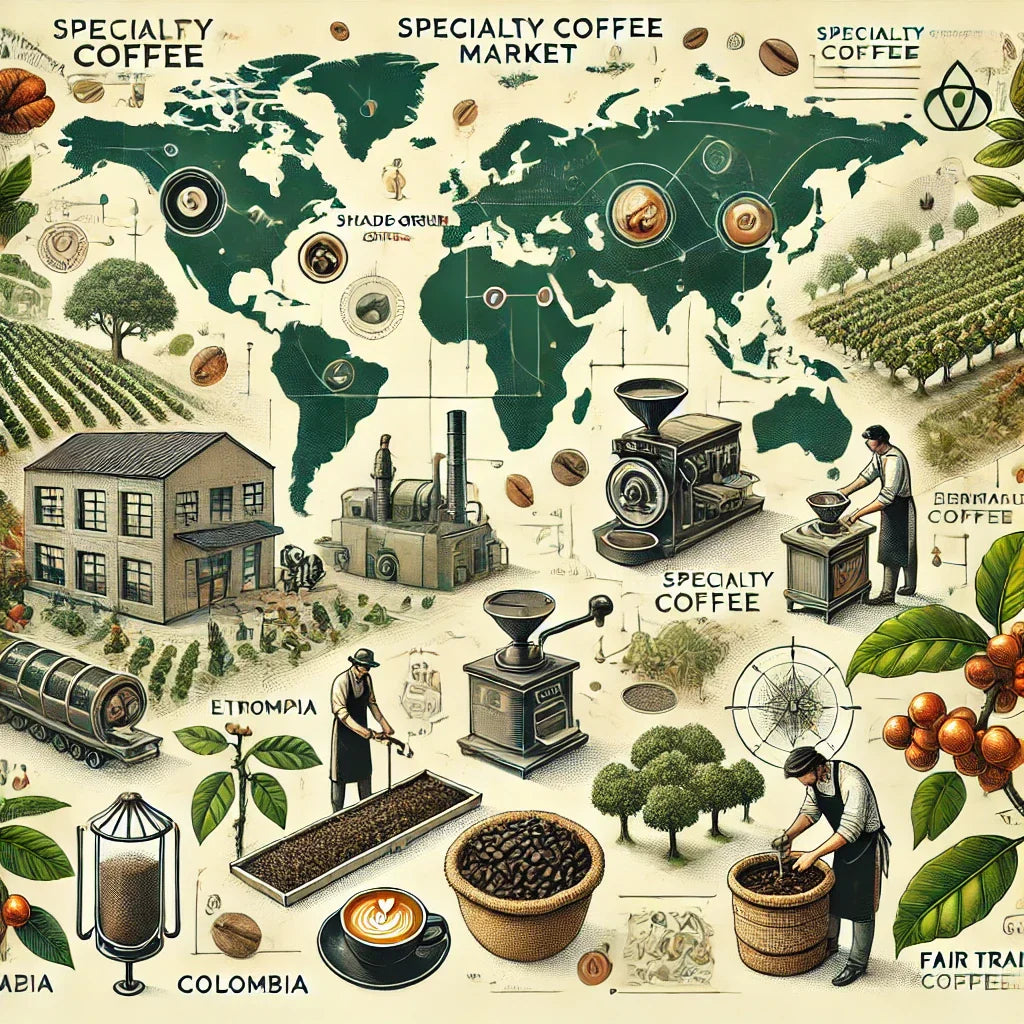
The dark side of the coffee market
Ah, coffee - our daily companion that kisses us awake in the morning and carries us through the day. But while we enjoy our cup, things are boiling behind the scenes in the coffee industry. Rising prices, quality issues and the role of speculators shed light on the complex world of coffee. Let's dive in together and find out why specialty coffee is not automatically the solution to all problems - and why sustainable partnerships and fair conditions are crucial.
Specialty coffee: a double-edged sword
Specialty coffee stands for top quality, special flavors and often also for sustainable cultivation. But beware: not all that glitters is gold.
Just because a coffee is labeled as a "specialty" does not necessarily mean that it was produced under fair or ecologically sustainable conditions. There is a risk that the focus on quality will narrow your view of social and ecological aspects.
Important questions you should ask yourself:
-
Is the coffee really grown sustainably or is it just using the label?
-
Do the producers receive fair prices or does the added value remain in the hands of a few traders?
-
How transparent is the supply chain of the coffee you drink?
The risk of declining quality despite higher prices
Another paradox: rising prices could mean that quality suffers. Why? When farmers suddenly realize higher revenues, they may be tempted to increase their production volume to profit even more. However, this can be at the expense of quality, especially if they lack the necessary resources or know-how to produce larger quantities at a consistently high level.
The problem:
-
More mass does not automatically mean more class.
-
Without long-term quality controls, the aroma and consistency of the coffee can deteriorate.
-
Instead of ensuring quality, the market could develop into an object of speculation.
The role of speculators: When coffee becomes a commodity
Coffee is traded like a commodity on the international stock exchanges, and speculators bet on price developments without ever holding a bean in their hands.
The consequences:
-
Price fluctuations: Coffee prices rise or fall regardless of the real production situation.
-
Uncertainty for coffee farmers: they are often unable to plan their income in a stable manner, which makes sustainable cultivation more difficult.
-
Higher costs for consumers: We end up paying more for coffee, but with no guarantee of better quality or fairer conditions for producers.
Sustainable partnerships are the key
To meet these challenges, sustainable partnerships along the entire supply chain are essential. This means:
1. fair payment
Coffee farmers must be paid fairly for their hard work. A stable and fair price secures them a dignified life and enables them to invest in sustainable cultivation methods.
2. long-term cooperation
Trust and stability are more important than short-term profits. Working with coffee farmers over the long term ensures sustainable quality and fair conditions.
3. training and support
Knowledge is the key to sustainable coffee production. By investing in training, farmers learn how to optimize their yields without compromising quality and the environment.
Conclusion: Conscious consumption as a guide
As coffee lovers, we have the power to influence our purchasing decisions. Pay attention to the following points the next time you buy:
✅ Certifications: Organic, Fairtrade or Demeter show a sustainable focus.
✅O rigin & transparency: Find out about the producers and their conditions.
✅S upport sustainable brands: Companies that have fair business models and transparent supply chains are actively helping to improve the coffee industry.
Because at the end of the day, coffee tastes best when we know that it has been produced under fair and sustainable conditions. Cheers to conscious enjoyment! ☕🌍



Specialty coffee in a fully automatic machine - how to make it taste really great! ☕🔥
Which coffee tastes best?