








Buying guide & comparison · Updated September 2026
Bezzera portafilter machines 2026: Which one suits you? (Buying guide, comparison & all models including the Nini series and Fast Heat)
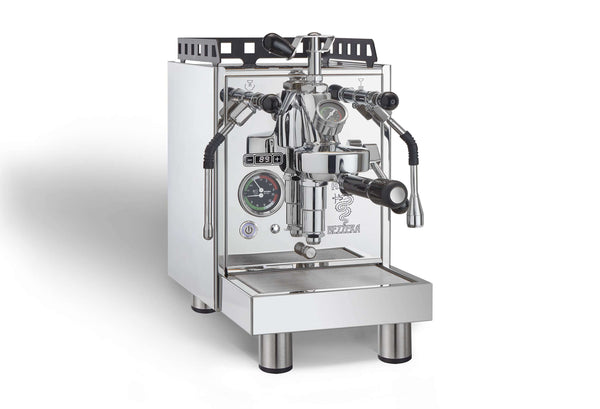
Bezzera is one of Italy's most traditional espresso machine manufacturers. The brand is known for robust engineering, strong value for money and, depending on the model, very short heat-up times thanks to Fast-Heat technology. In this updated 2026 buying guide you will find a quick decision aid, all model recommendations including the new Nini series and answers to common questions, with direct links to the matching machines.
Directly to the Bezzera collection: View all Bezzera portafilter machines
Quick pick: the right Bezzera in 30 seconds
I want a compact entry (espresso focus)
Then the new Nini series is ideal: compact two-circuit with heat exchanger, classic controls and small footprint. Choice depends on desired control comfort and whether you want PID.
- Bezzera Nini PM (manual, entry-level)
- Bezzera Nini DE (with dosing electronics)
- Bezzera Nini PID PM (PID + manual)
- Bezzera Nini PID DE (PID + dosing)
I mostly drink espresso (no milk)
For maximum reproducibility and temperature control, single boilers or two-circuit machines with PID are suitable. If you want to upgrade later: Flow Control can be retrofitted on E61 brew groups.
- Bezzera Luce (classic, compact)
- Bezzera Luce PID (more control over temperature)
- Bezzera Luce S PID Fast Heating Inox (E61 + Fast Heat)
I make cappuccino & latte often
Two-circuit machines or dual boilers allow brewing and steaming simultaneously. For more convenience, DE versions with volumetric dosing are worth it.
I want to be ready quickly (Fast Heat)
Fast-Heat models have an additionally heated E61 brew group and are therefore up to 20 minutes faster to be ready for use than standard E61 machines. Ideal for spontaneous espressos in the morning or in the office.
- Bezzera Luce S PID Fast Heating Inox
- Bezzera Sole Top PID Fast Heat Inox
- Bezzera Aria Top Fast Heating (compact, rotary pump, plumb-in possible)
I want tech & features (display, profiles, more control)
Then the "Top" models are interesting: more control, more comfort and, depending on version, volumetrics.
Bezzera Nini series: the new compact entry
The Bezzera Nini was introduced in 2026 as a compact two-circuit machine and positions itself technically and price-wise as the smaller, space-saving sibling of the Luce. With only 25 cm width and a 1.5 l copper heat exchanger it fits even in small kitchens without giving up the typical Bezzera workflow feel.
The essentials in short:
- Architecture: two-circuit with 1.5 l copper boiler (heat exchanger)
- Brew group: Bezzera BZ brew group (58 mm portafilter), mechanical pre-infusion
- Tank: 3 l, rear, vibration pump
- Dimensions: 365 × 250 × 448 mm (H × W × D), 20 kg
- Power consumption: 1.100 to 1.300 W
- Cup warmer: passive · Steam power: medium · Standby: not available · App control: not available
Four variants differ along two dimensions: control type (PM = manual vs. DE = dosing electronics with volumetric programming) and temperature control (with or without PID including shot timer).
Comparison table: Which Nini suits you?
| Feature | Nini PM | Nini DE | Nini PID PM | Nini PID DE |
|---|---|---|---|---|
| Control | manual (lever/button) | volumetric (dosing electronics) | manual (lever/button) | volumetric (dosing electronics) |
| PID control | no | no | yes (brew boiler) | yes (brew boiler) |
| Shot timer | no | no | yes | yes |
| Flow Control | not provided | not provided | optional | optional |
| Ideal for | Beginners, purists, small budget | Comfort-oriented users, multiple users in one household | Home baristas with temperature demands & workflow focus | Demanding home baristas seeking comfort |
| Price level (RRP DACH) | cheap | moderate | mid | upper |
Short recommendation: If you already work with scale and timer and want control to stay with you, the Nini PID PM is the sweet spot. If multiple people in the household dose differently or you want reproducible cups without thinking, the Nini PID DE is worth it. The non-PID versions are the choice for limited budget or if you want to experiment with bean profiles without extra control.
Fast Heat & Fast Heating: what does it mean technically, and who benefits from the extra cost?
Classic E61 brew groups consist of a massive brass block that is thermally flushed by the boiler water and therefore brought to brewing temperature. That is robust and temperature-stable, but depending on the machine and ambient temperature it typically takes 20 to 30 minutes until the group is really ready.
Bezzera's Fast Heat and Fast Heating technology integrates an additional heating element directly into the E61 brew group. The group is therefore actively heated independently from the boiler.
Concrete everyday advantage
- Warm-up time saving: up to around 20 minutes compared to standard E61
- Better responsiveness: the group "drops" less when you brew again after a longer pause
- Same stability: the thermal mass of the E61 group remains, you lose nothing
Who benefits from the extra cost?
| Argues for Fast Heat | Argues against Fast Heat |
|---|---|
| You pull a spontaneous espresso in the morning without 30 minutes lead time | You switch the machine on early anyway and then work with it for longer sessions |
| Office or practice setup with irregular brew times | You prefer pure standard E61 character without active group heating |
| More than 5 to 10 pulls daily, spread over the day | You want the cheapest model in the respective line |
Available on three models:
- Bezzera Luce S PID Fast Heating Inox: compact two-circuit with E61, vibration pump, 4 l tank
- Bezzera Sole Top PID Fast Heat Inox: semi-professional with rotary pump, 4 l tank, quiet operation
- Bezzera Aria Top Fast Heating: compact two-circuit with E61 and rotary pump, 25 cm wide, 3 l tank or plumbed-in connection. According to the manufacturer up to 20 minutes faster ready for use.
MN, DE and PM: what do the Bezzera abbreviations mean?
Bezzera uses a number of abbreviations that can be confusing at first glance but follow a clear logic:
| Abbreviation | Meaning | What that means in practice |
|---|---|---|
| MN | Manuale (manual version) | You start and stop the extraction yourself: barista workflow. |
| PM | Pulsantiera Manuale (manual keypad) | Used for the Nini series: manual extraction via button, without volumetric programming. |
| DE | Dosatura Elettronica (dosing electronics) | Programmable brew buttons for volumetric dosing: convenience and consistency. |
| PID | Proportional-Integral-Derivative | Electronic temperature control of the brew boiler: more constant brew temperature. |
| Top | Top equipment | Marks the higher-end equipment within a model line. |
| Fast Heat / Fast Heating | heated E61 brew group | Additional heating element in the E61 group: significantly shorter warm-up time. |
In short: MN/PM = manual, DE = volumetric, PID = precise temperature, Fast Heat = ready quickly.
PID & Flow Control: when is it worth it?
PID (temperature control)
PID is especially worthwhile if you frequently change beans, drink light roasts or want reproducible shots. On "PID" models you typically have finer control over brew temperature and usually an integrated shot timer.
Flow Control (flow/pressure control)
Important: Flow Control can generally be retrofitted on all E61 brew groups. This is ideal if you later want to experiment with pre-infusion and pressure profiling without buying a completely new machine setup. The Bezzera Flow Control Kit is explicitly designed for E61 brew groups and intended as an upgrade.
Note on the Nini series: The Nini uses the Bezzera BZ brew group, not E61. Flow Control in the classic E61 sense is optionally provided on the PID versions here; the standard E61 Flow Control Kit does not fit.
MN/PM vs. DE: which is better?
MN/PM = manual, DE = volumetric. It is less a question of quality and more a question of style.
| Question | MN / PM (manual) | DE (volumetric) |
|---|---|---|
| Operation | You start and stop the extraction yourself. | You use programmable brew buttons (amount / volume). |
| For whom? | Purists, those willing to learn, experimenters. | Everyday use, multiple users in one household, consistency at the push of a button. |
| Result | Perfect if you already work with a scale and timer. | Very convenient. Scale and fine-tuning still make sense. |
All Bezzera models 2026 at Naturbohne at a glance
Entry & espresso focus
Milk drinks & all-rounders
Demanding home baristas & top equipment
FAQ: Typical questions before buying
What distinguishes the Bezzera Nini from the Luce?
The Nini is more compact (250 mm width vs. approx. 305 mm for the Luce), uses the Bezzera BZ brew group instead of E61 and is positioned at a lower price point. The Luce, especially the Luce S PID Fast Heating, relies on the classic E61 brew group with a larger thermal mass. If you want maximum space savings and an espresso focus, choose the Nini. If you want to use the E61 ecosystem long-term (Flow Control, standard spare parts), choose the Luce.
What does Fast Heat actually provide?
Fast Heat reduces the warm-up time compared to a standard E61 brew group by up to around 20 minutes. Instead of 20 to 30 minutes lead time the machine is ready to use in significantly less time because an additional heating element sits directly in the E61 brew group. Temperature stability remains.
What does PM mean on the Bezzera Nini?
PM stands for "Pulsantiera Manuale", i.e. manual keypad operation. You start and stop the extraction yourself, without volumetric programming. In contrast, DE (Dosatura Elettronica) stands for volumetric dosing electronics with programmable brew buttons.
BZ brew group vs. E61: is it a huge taste difference?
In practice the difference is usually smaller than expected. More relevant are temperature stability in the workflow, warm-up time, maintenance and whether you want to use Flow Control. E61 is strong in terms of ecosystem, BZ is more compact and quicker to get ready.
Flow Control: can I retrofit it later?
For E61 brew groups Flow Control can generally be retrofitted. The Bezzera Flow Control Kit is explicitly designed for E61 and intended as an upgrade. On the Nini series with BZ group Flow Control is only optionally provided on the PID versions.
MN, PM or DE: which is "better"?
It is a question of style. MN and PM are manual, ideal for the barista workflow with scale and timer. DE provides volumetric dosing and more convenience, especially if multiple people use the machine or you want consistent shots without thinking.
Is the extra cost for a Fast-Heat model worth it?
If you use the machine spontaneously (morning, office, irregular brew times), then yes. If you switch it on early anyway and have long sessions, a standard E61 is perfectly sufficient.
What distinguishes the Sole Top PID Fast Heat Inox from the Sole Top PID MN?
Both models share the platform (two-circuit, E61, rotary pump, top equipment with PID). The Fast-Heat version additionally has a heated E61 brew group and is therefore significantly faster ready for use. If you value short warm-up times and stainless steel look, choose the Fast-Heat variant.
What distinguishes Bezzera from Rocket?
Bezzera is often more pragmatic (engineering and value for money) and depending on the brew group has faster ready times. Rocket traditionally places a lot of emphasis on design and fit and finish. Espresso quality ultimately depends heavily on grinder, beans and setup. Both brands can be excellent.
Stay tuned: Bezzera deals & setup tips (newsletter)
If you are currently in the decision phase, that is normal: you compare and quickly forget shops. With our newsletter you will receive (1) reminder impulses, (2) possibly offers and restocks and (3) practical setup tips. Sign up for the newsletter


