








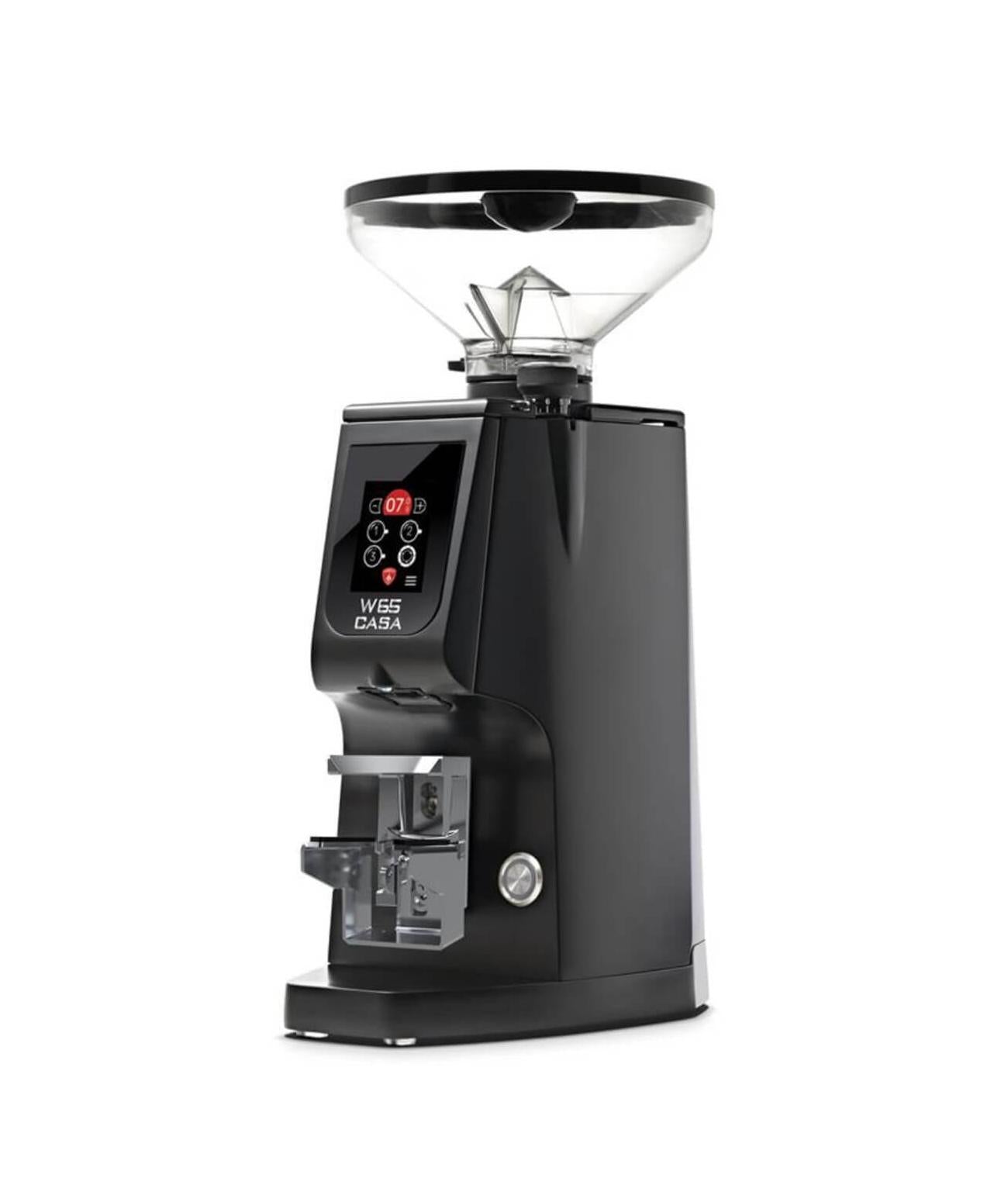
Eureka Atom W Casa 65 GbW.
incl. VAT
Finanzieren ab 49,17 € / Monat* mit
🚚 Shipping within EU: 34 €
EU shipping costs, see shipping policy.
Eureka Atom W Casa 65 GbW.
Eureka Atom W Casa 65 GbW: Precision in every bean
The Eureka Atom W 65 GbW is the latest evolution of the popular Atom series, combining Italian design with state-of-the-art technology for the highest dosing accuracy. Thanks to the integrated Grind-by-Weight function (GbW), the grinder mills precisely by weight — for consistent results, less waste and greater control with every espresso shot.
The 65 mm flat steel burrs provide an even particle distribution and perfect extraction. The proven Silent Technology enables extremely quiet grinding, ideal for use in cafés or at home. The patented ACE system effectively reduces clumping and static charge.
Why the Atom W 65 GbW?
- Automatic weight dosing for maximum consistency
- 65 mm steel burrs for precise grinding
- Stepless micrometric grind adjustment
- Quiet operation thanks to Silent Technology
- Large color touch display with intuitive controls
- High-quality craftsmanship "Made in Italy"
Technical specifications
| Feature | Specification |
|---|---|
| Burrs | Flat steel, Ø 65 mm |
| Motor power | 320 W direct drive |
| Dosing | Grind-by-Weight (integrated scale) |
| Grinding rate | approx. 2–3.5 g/s |
| Operating noise level | Silent Technology ≈ 55 dB |
| Bean hopper | approx. 1.2 kg |
| Dimensions (W × D × H) | 180 × 240 × 540 mm |
| Weight | 8.5 kg |
Included
- Eureka Atom W 65 GbW espresso grinder
- Bean hopper (300 g)
- Portafilter holder with adjustable height
- Power cord & user manual
Difference from the Eureka Atom W 65 (standard version)
| Function | Atom W 65 GbW | Atom W 65 |
|---|---|---|
| Dosing system | Grind-by-Weight – automatic weight dosing | Time- or volume-based |
| Operation | Color touch display | Standard display |
| Consistency | ± 0.1 g deviation | ± 0.5 g deviation |
| Workflow | Fully automatic | Manual adjustment required |
| Target audience | Professionals & ambitious home baristas | Home users & beginners |
Conclusion
The Eureka Atom W 65 GbW sets new standards for precision and convenience in the espresso workflow. With its weight dosing, quiet operation and high-quality construction, it is the ideal choice for those who want uncompromising control over their grinding process.
Manufacturer information
* Bonität vorausgesetzt. Ratenbeispiel für PayPal Ratenzahlung: effektiver Jahreszins 12,49 % p.a., fester Sollzinssatz 11,80 % p.a., Laufzeit 24 Monate. Genaue Konditionen und Gesamtkosten werden im nächsten Schritt von PayPal angezeigt. Angebot gültig nur für Kunden mit Wohnsitz in Deutschland. Weitere Infos zur Bonitätsprüfung.
If you have any questions, you can contact us at any time. We will get back to you as quickly as possible, on weekdays within 24 hours.
-
Shipping info
We ship all products on the same day for orders placed by 13:00.
-
Support
Even after your purchase we are here to support you and advise you. If you have questions about the product you bought from us, please contact us.
-
Contact
Email: [email protected]
Phone: 07454 / 870 48 64
What customers ask about
Steht deine Frage nicht dabei, schreib uns. Wir antworten persönlich, meist am selben Werktag.
Eigene Frage stellen →I bought a new coffee grinder from Naturbohne and there are coffee grounds in it.
Please note: Some manufacturers test their coffee grinders before shipping, which can occasionally leave small coffee residues or bean fragments in the grinder. This procedure serves as a functional test and is considered a sign of quality. Of course we sell only new goods, unless explicitly stated otherwise.
Static charge, coffee grounds spray out sideways
With some coffee grinders it can happen that the ground coffee becomes statically charged and squirts out sideways from the portafilter. As a result not all ground coffee reaches the portafilter, which can lead to uneven extraction. Our recommendation: Use a dosing funnel to ensure that all ground coffee is guided precisely into the portafilter, for optimal espresso enjoyment.
What is the dead space in coffee grinders?
In conventional coffee grinders there is often a so-called retention chamber where coffee residues collect. These residues can not only impair freshness but also cause old and fresh ground coffee to mix, which negatively affects the taste. In contrast, single-dose grinders have a thoughtful design that eliminates the retention chamber. Each portion is ground individually and precisely so that no residues remain, for a consistently pure and full-bodied coffee enjoyment.
Which portafilter fits my espresso machine?
When choosing the right portafilter for your portafilter machine it is important to know that every manufacturer develops its own brew group, the most famous being the Faema E61. However this does not mean that any portafilter will necessarily fit. A portafilter that is not compatible may leak, which immediately has a negative effect on the quality of your espresso. Therefore we recommend either using the portafilter that was originally supplied or one that is explicitly stated to be compatible with your machine. This way you ensure that the pressure builds up optimally and the espresso is perfectly extracted.
Can I visit you or pick up the goods in person?
Sure, by appointment you are welcome to come by and look at our products. We will gladly advise you in person. It is best to send us an email with a few proposed appointment times.
We are located 5min from the motorway between Stuttgart and Bodensee on the edge of the Schwarzwald.
Important note, first use of coffee grinders
One small tip for the perfect start with your new grinder:
You will achieve the best grind after you have ground about 1-2 kg of beans. It is best to use a few inexpensive beans for this so that the grinding mechanism can run in optimally. And if you are wondering what you can do with the coffee grounds, perfect plant fertilizer! 🌿
It contains nitrogen, potassium, sulfur and phosphorus and is a real nutrient bomb for your plants.
Can you perform an offset calibration on my portafilter espresso machine?
There are several arguments against offset calibration on Lelit portafilter machines, especially on models like the Lelit Bianca. These relate mainly to the complexity and the limitations of the offset as a sole solution for temperature issues:
- Temperature fluctuations and instability. The offset accounts for a constant difference between boiler temperature and brew temperature. In practice, however, temperature fluctuations can occur, e.g. due to longer idle periods or continuous brewing. As a result, the actual brew temperature is not always precisely predictable.
- Dependence on environmental conditions. Factors such as room temperature, humidity and the condition of the machine (e.g. heat-up time) significantly affect the brew temperature. A fixed offset cannot dynamically compensate for these variables, which can lead to inaccurate results.
- Heat loss during idle periods. After longer breaks the group head cools down and the machine needs time to return to the desired temperature. A correctly set offset cannot compensate for this, which is why additional measures like a “Cooling Flush” are necessary.
- Factory miscalibrations. On some Lelit models it has been found that the offset is often set inaccurately at the factory (e.g. 4–8 degrees too low on the Lelit Bianca). This requires manual recalibration by qualified personnel, which can be complicated for end users.
- Misunderstandings in application. Many users are unsettled by contradictory information about offset settings, which can lead to misadjustments. For example, it is often expected that the offset alone will solve all temperature problems, although it is only part of a more complex system.
Conclusion
Offset calibration is a useful tool, but it should not be viewed in isolation. A combination of precise PID control, regular maintenance and adapted techniques (e.g. flushing shots) is necessary to achieve optimal brewing results.
No reviews yet
Do you have any more questions?
Contact
If you still have questions about our products, feel free to write to us here or use the chat function.