

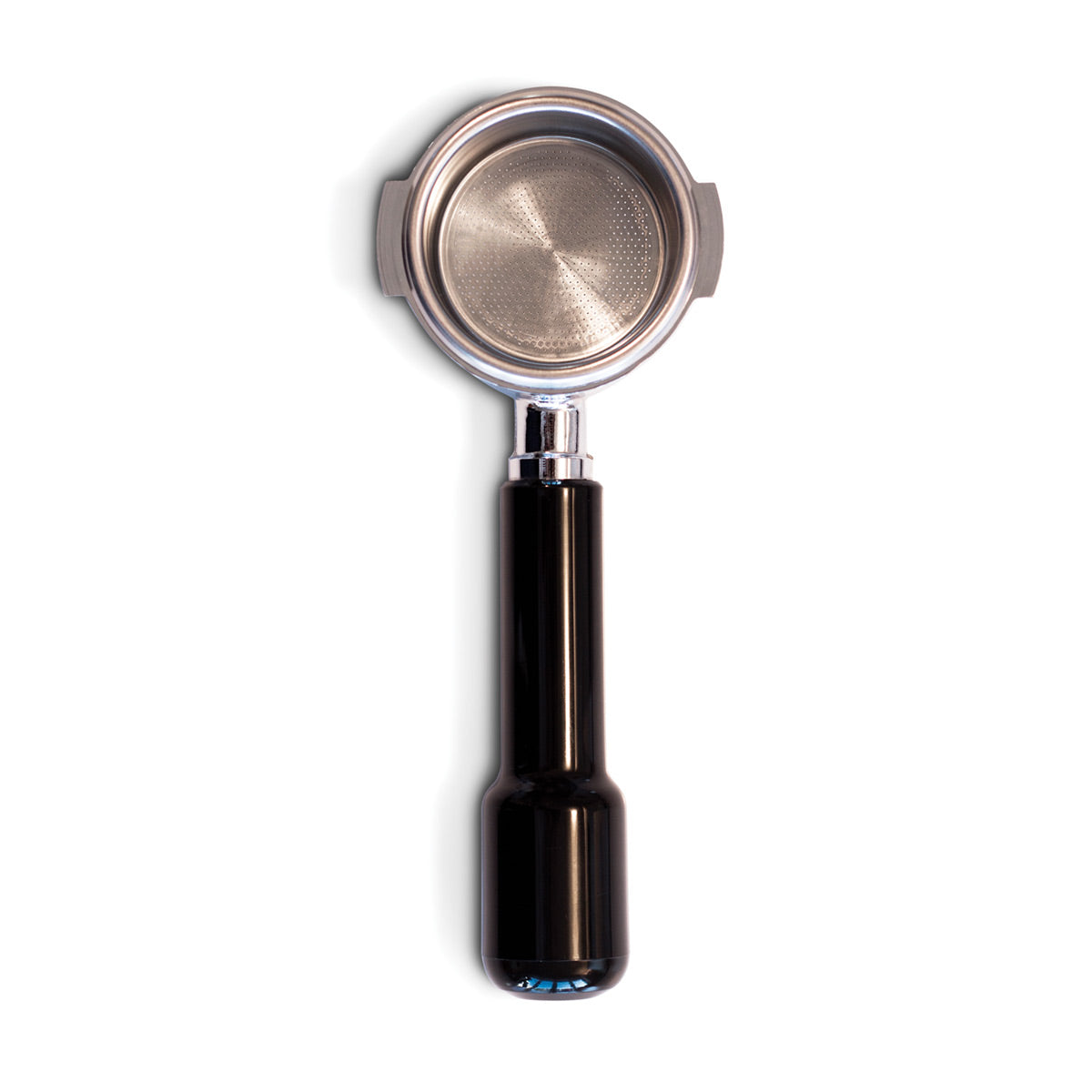

Bottomless portafilter for Rocket E61 - 58 mm | Original Rocket
incl. VAT, excluding shipping costs
🚚 Shipping within EU: 8 €
EU shipping costs, see shipping policy.
Bottomless portafilter for Rocket E61 - 58 mm | Original Rocket
Bottomless portafilter for Rocket E61 - 58 mm | Original Rocket
The bottomless portafilter for Rocket espresso machines with E61 brew group is the ideal upgrade for discerning home baristas and professionals who want to visibly improve their espresso extraction. The open portafilter base allows the brewing process to be experienced directly - for maximum control, a better understanding of the extraction and optimum results in the cup.
This original Rocket bottomless portafilter (58 mm) is precisely manufactured, has a high-quality finish and is compatible with all Rocket espresso machines with an E61 brew group as well as many other E61 machines from other manufacturers.
Why a bottomless portafilter?
A bottomless portafilter - also known as a naked portafilter - does away with the classic spout. This allows you to observe the espresso directly under the portafilter and immediately see whether the grind, dosage, distribution or roping are optimally set.
- Direct view of the extraction
- Immediate detection of channeling or uneven distribution
- Improved technique, consistency and taste
- More crema and clearer cup appearance with clean extraction
Original Rocket quality
The portafilter comes from the Original Rocket range of accessories and impresses with its precise fit, clean threads and high-quality materials. The ergonomically shaped handle sits comfortably in the hand and looks perfect with Rocket espresso machines such as Appartamento, Mozzafiato, Giotto or R58.
Compatibility
The bottomless portafilter is compatible with:
- Rocket espresso machines with E61 brew group
- All standard E61 machines with 58 mm strainers
- Standard portafilter baskets (e.g. 18 g, 20 g, 21 g - depending on the design)
Note: The portafilter is usually supplied without a portafilter insert so that you can continue to use your preferred precision portafilter.
Technical data
| Product type | Bottomless portafilter / Naked portafilter |
|---|---|
| Filter diameter | 58 mm |
| Brew group | E61 |
| Material | Chrome-plated brass (portafilter head), handle made of wood or plastic (depending on model) |
| Manufacturer: Rocket | Rocket Espresso |
| Compatible strainers | Standard and precision strainers (e.g. IMS, VST) |
Who is this portafilter suitable for?
- Home baristas who want to specifically improve their espresso quality
- Beginners who want to learn proper technique
- Advanced baristas who want to fine-tune their grind and distribution
- Rocket owners who value original accessories and design harmony
Practical tip
In combination with a good tamper, a leveler and a precise grind, the bottomless portafilter helps you to achieve reproducible results. Small errors in the workflow become visible - and can be corrected in a targeted manner.
Conclusion
The bottomless port afilter for Rocket E61 (58 mm) is one of the most useful upgrades for any portafilter machine. It not only improves extraction and taste, but also makes espresso preparation more transparent, more instructive and much more consistent. A must-have for anyone who takes espresso seriously.
Información sobre el fabricante
* Bonität vorausgesetzt. Ratenbeispiel für PayPal Ratenzahlung: effektiver Jahreszins 12,49 % p.a., fester Sollzinssatz 11,80 % p.a., Laufzeit 24 Monate. Genaue Konditionen und Gesamtkosten werden im nächsten Schritt von PayPal angezeigt. Angebot gültig nur für Kunden mit Wohnsitz in Deutschland. Weitere Infos zur Bonitätsprüfung.
If you have any questions, please feel free to contact us at any time. We will get back to you as soon as possible, within 24 hours on weekdays.
-
Shipping info
We ship all products the same day if ordered before 1pm.
-
Soporte
We will also be there to support you and advise you after your purchase. If you have any questions about the product you purchased from us, please contact us.
-
Contact
Email: hello@naturbohne.de
Teléfono: 07454 / 870 48 64
Frequently Asked Questions
I bought a new coffee grinder from Naturbohne and there are coffee residues in it.
Please note: Some manufacturers test their coffee grinders before shipping, which means that small coffee residues or bean residues can occasionally be found in the grinder. This procedure is used to test functionality and is considered a quality feature. Of course, we only sell new products - unless expressly stated otherwise.
Static charge – coffee grounds spray out from the side
With some coffee grinders, the ground coffee can become statically charged and spray out of the portafilter at the side. This means that not all of the ground coffee gets into the portafilter, which can lead to uneven extraction. Our recommendation: Use a dosing funnel to ensure that all of the ground coffee is precisely fed into the portafilter - for optimal espresso enjoyment.
What is dead space in coffee grinders?
Conventional coffee grinders often leave a so-called dead space in which coffee residues accumulate. These residues can not only affect the freshness, but also lead to old and fresh coffee grounds being mixed, which negatively affects the taste. In contrast, single dose grinders have a well-thought-out design that eliminates the dead space. Each portion is ground individually and precisely so that no residues are left behind - for a consistently pure and full-bodied coffee experience.
Which portafilter fits my espresso machine?
When choosing the right portafilter for your portafilter machine, it is important to know that each manufacturer develops its own brewing group - the most well-known is the Faema E61. However, this does not mean that any portafilter will fit without any problems. An incompatible portafilter can leak, which will have a direct negative impact on the quality of your espresso. We therefore recommend using either the portafilter originally supplied or one that is explicitly stated to be compatible with your machine. This will ensure that the pressure is optimally built up and the espresso is perfectly extracted.
Can I visit you or pick up the goods personally?
Yes, of course, you are welcome to come by and look at our products by appointment. We would be happy to advise you personally. The best thing to do is to send us an email with a few suggested appointment times.
We are located 5 minutes from the motorway between Stuttgart and Lake Constance on the edge of the Black Forest.
Important note, first use coffee grinders
Another little tip for the perfect start with your new mill:
You will get the best grinding result after you have ground about 1-2 kg of beans. It is best to use a few cheap beans so that the grinder can work optimally. And if you are wondering what you can do with the bean flour - it is perfect plant fertilizer! 🌿
It contains nitrogen, potassium, sulfur and phosphorus and is a real nutrient bomb for your plants.
¿Pueden realizar una calibración de offset en mi máquina de portafiltro?
Existen varios argumentos en contra de una calibración de compensación en las máquinas de portafiltro Lelit, especialmente en modelos como la Lelit Bianca. Estos se refieren principalmente a la complejidad y las limitaciones de la compensación como única solución para problemas de temperatura:
- Fluctuaciones de temperatura e inestabilidad. La compensación considera una diferencia constante entre la temperatura de la caldera y la temperatura de preparación. Sin embargo, en la práctica pueden ocurrir fluctuaciones de temperatura, por ejemplo, debido a tiempos de espera prolongados o preparación continua. Esto hace que la temperatura de preparación real no siempre sea predecible con precisión.
- Dependencia de las condiciones ambientales. Factores como la temperatura ambiente, la humedad y el estado de la máquina (por ejemplo, el tiempo de calentamiento) afectan significativamente la temperatura de preparación. Una compensación fija no puede equilibrar dinámicamente estas variables, lo que puede llevar a resultados inexactos.
- Pérdida de calor durante los tiempos de espera. Después de pausas prolongadas, el grupo de preparación se enfría y la máquina necesita tiempo para volver a la temperatura deseada. Una compensación correctamente ajustada no puede compensar esto, por lo que son necesarias medidas adicionales como un "Cooling Flush".
- Desajustes de fábrica. En algunos modelos de Lelit se ha encontrado que la compensación de fábrica a menudo está configurada de manera inexacta (por ejemplo, de 4 a 8 grados demasiado baja en la Lelit Bianca). Esto requiere una recalibración manual por parte de personal especializado, lo cual puede ser complicado para los usuarios finales.
- Malentendidos en la aplicación. Muchos usuarios están confundidos por la información contradictoria sobre la configuración de la compensación, lo que puede llevar a ajustes incorrectos. Por ejemplo, a menudo se espera que la compensación por sí sola resuelva todos los problemas de temperatura, aunque solo es parte de un sistema más complejo.
Conclusión
La calibración de compensación es una herramienta útil, pero no debe considerarse de forma aislada. Una combinación de control PID preciso, mantenimiento regular y técnicas adaptadas (por ejemplo, "spülshots") es necesaria para lograr resultados óptimos de preparación.
Do you have any more questions?
Contact
If you have any questions about our products, please write to us here or use the chat function.