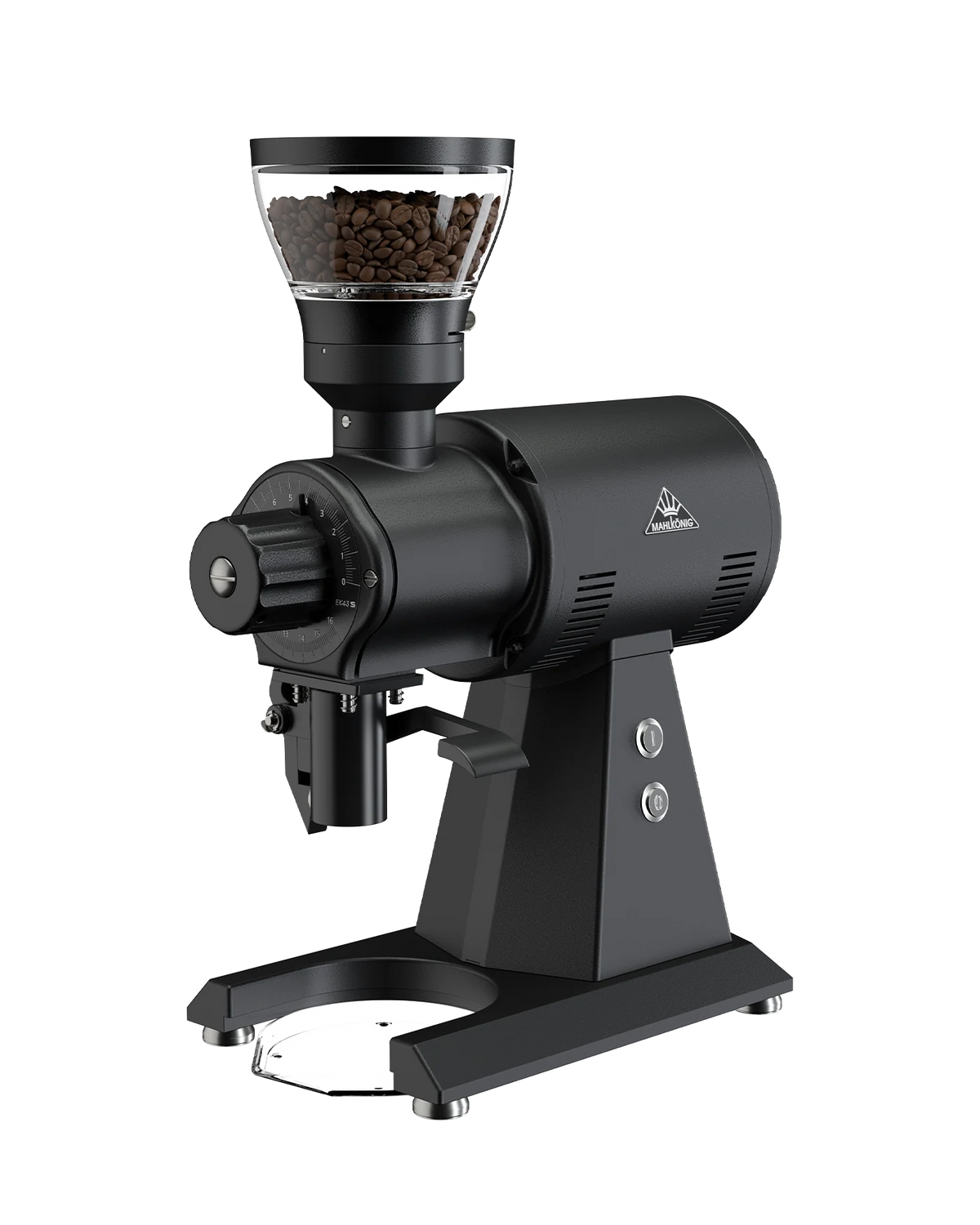

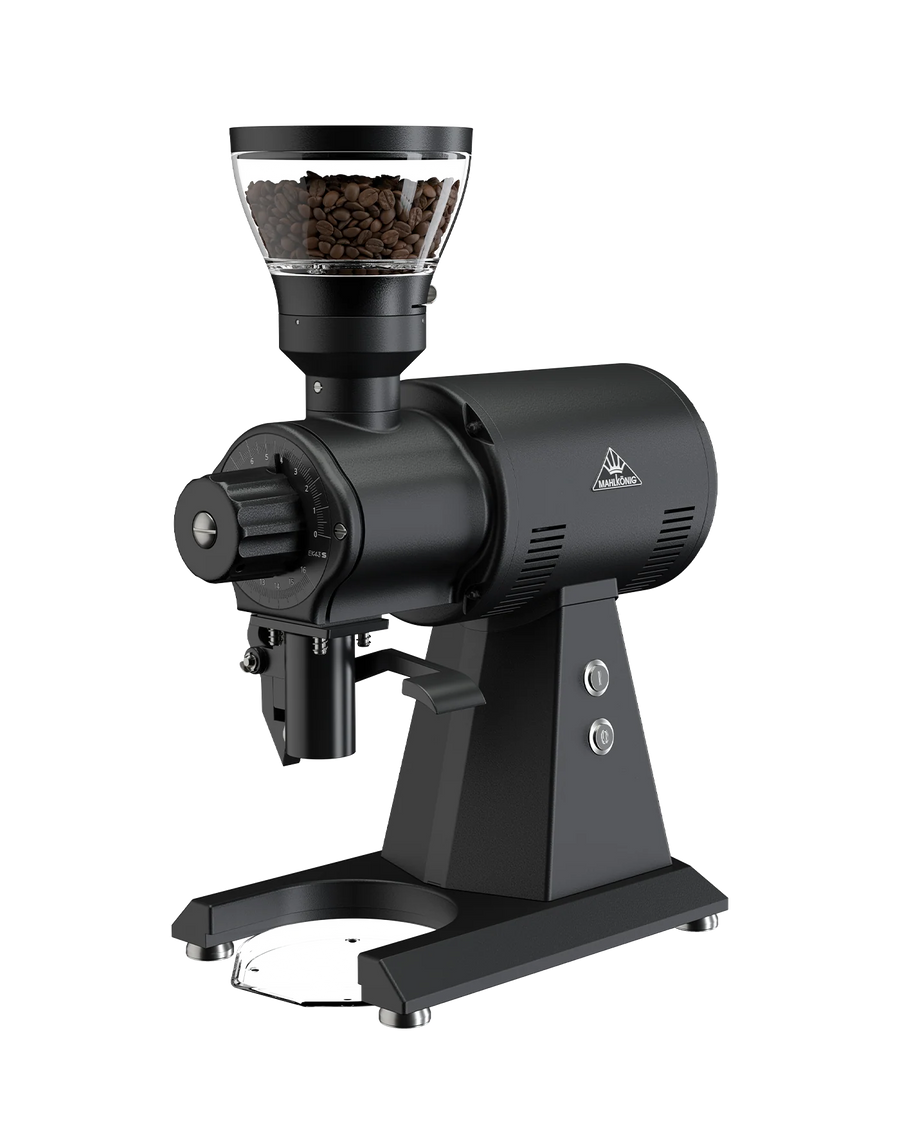
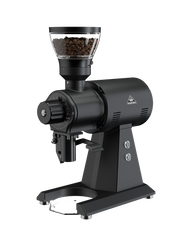
Mahlkönig EK43s – Profi Allround-Kaffeemühle mit Premium-Mahlscheiben

Die Mahlkönig EK43s ist eine der weltweit begehrtesten Profi-Kaffeemühlen für Kaffeehäuser, Röstereien, Gastronomie und anspruchsvolle Home-Baristas. Aufbauend auf dem legendären Ruf der klassischen EK43 bringt die kompaktere EK43s dieselbe Premium-Performance in ein platzsparenderes Format – mit herausragender Mahlqualität, gleichmäßiger Partikelverteilung und vielseitiger Einsatzfähigkeit für alle Kaffeebereiche. 

Leistungsstarke Mahlqualität für höchste Ansprüche

Ausgestattet mit präzisen 98 mm Mahlscheiben aus gehärtetem Stahl und einem kräftigen Motor liefert die EK43s konstante, gleichmäßige Vermahlung – ideal für Espresso, Filterkaffee, French Press oder sogar türkisch feine Mahlgrade. Die klassische Mahlkönig-Partikelgröße sorgt für hervorragende Extraktion, maximale Aromaentfaltung und erstaunliche Geschmacksbalance bei jedem Brühvorgang. 

Vielseitiger Einsatz

Die EK43s eignet sich sowohl für den täglichen Profi-Einsatz in Kaffeebergen, Cafés und Röstereien als auch für ambitionierte Home-Baristas, die höchste Präzision und Konsistenz verlangen. Dank der stabilen Konstruktion und robusten Mahltechnik ist sie auch bestens für dauerhaft hohe Belastungen geeignet. 

Typische Fragen von Anwendern

  • Ist die EK43s auch für Espresso geeignet?
    Ja – mit ihren 98 mm Mahlscheiben erreicht die EK43s exzellente Ergebnisse für Espresso bis grobe Filtervertretungen. Sie bietet ein breites Mahlgrad-Spektrum.
  • Kann ich die Mühle für andere Mahlgüter nutzen?
    Ja – mit entsprechenden Mahlscheiben ist die EK43s auch für Gewürze, Getreide oder Samen einsetzbar.
  • Wie hoch ist die Leistung?
    Mit leistungsstarkem Motor und großen Scheiben bietet sie hohe Mahlleistung für nahezu alle Kaffeezubereitungen.

Für wen ist die EK43s gedacht?

Die Mahlkönig EK43s richtet sich an professionell arbeitende Baristas und Kaffeeprofis, Röstereien, Cafés mit hohem Durchsatz, Shops mit Bohnenverkauf und ambitionierte Kaffeeenthusiasten, die außergewöhnliche Mahlqualität und maximale Flexibilität erwarten. Sie ist sowohl für Espresso- als auch Filterkaffee-Zubereitungen ausgelegt und gilt als Goldstandard in der spezialisierten Barista-Szene. 

Technische Daten

Mahlscheiben 98 mm Premium-Hartgussstahl
Motorleistung ca. 1300 W
Leerlaufdrehzahl ca. 1450 U/min (50 Hz) / 1760 U/min (60 Hz)
Fassungsvermögen Bohnenbehälter ca. 800 g
Mahlgradverstellung stufenlose Feineinstellung
Vielseitiger Einsatz Espresso, Filter, French Press, türkisch fein etc.
Gewicht ca. 24,5 kg
Abmessungen (B×H×T) ca. 23 × 68 × 41 cm


Unterschiede: EK43 vs EK43s vs EK Omnia

Modell Platzbedarf Funktionen Mahlmodi & Technik Geeignet für
EK43 Größere Grundfläche, Klassiker Ultimative Partikelverteilung Standard mahlt für Spezialitätenkaffee High-End Cafés, Röstereien
EK43s Kompakter, platzsparender Gleiche Mühle wie EK43 mit reduzierter Bauform Vielseitig für Espresso bis Filter Cafés, Shops, anspruchsvolle Home-Baristas
EK Omnia Modernes Design mit Display Erweiterte digitale Steuerung 3 Modi + Rezeptspeicherung, Touchscreen Profis und High-Volume Settings


Warum die EK43s in Deutschland, Österreich & Schweiz beliebt ist

In der DACH-Region vertrauen Kaffeeröstereien, Spezialitäten-Cafés und leidenschaftliche Baristas auf die EK43-Serie wegen ihrer Präzision, Zuverlässigkeit und Performance. Die kompaktere EK43s kombiniert legendäre Mahlqualität mit geringerem Platzbedarf – ideal für deutsche, österreichische und schweizer Kaffeeprofis in engen Theken oder Showrooms.

Informations sur le fabricant

Hemro Manufacturing Germany GmbH, Tilsiter Strasse 144, 22047 Hamburg, www.mahlkoenig.com, info@hemrogroup.com

* Bonität vorausgesetzt. Ratenbeispiel für PayPal Ratenzahlung: effektiver Jahreszins 12,49 % p.a., fester Sollzinssatz 11,80 % p.a., Laufzeit 24 Monate. Genaue Konditionen und Gesamtkosten werden im nächsten Schritt von PayPal angezeigt. Angebot gültig nur für Kunden mit Wohnsitz in Deutschland. Weitere Infos zur Bonitätsprüfung.

Frequently Asked Questions

I bought a new coffee grinder from Naturbohne and there are coffee residues in it.

Please note: Some manufacturers test their coffee grinders before shipping, which means that small coffee residues or bean residues can occasionally be found in the grinder. This procedure is used to test functionality and is considered a quality feature. Of course, we only sell new products - unless expressly stated otherwise.

Static charge – coffee grounds spray out from the side

With some coffee grinders, the ground coffee can become statically charged and spray out of the portafilter at the side. This means that not all of the ground coffee gets into the portafilter, which can lead to uneven extraction. Our recommendation: Use a dosing funnel to ensure that all of the ground coffee is precisely fed into the portafilter - for optimal espresso enjoyment.

What is dead space in coffee grinders?

Conventional coffee grinders often leave a so-called dead space in which coffee residues accumulate. These residues can not only affect the freshness, but also lead to old and fresh coffee grounds being mixed, which negatively affects the taste. In contrast, single dose grinders have a well-thought-out design that eliminates the dead space. Each portion is ground individually and precisely so that no residues are left behind - for a consistently pure and full-bodied coffee experience.

Which portafilter fits my espresso machine?

When choosing the right portafilter for your portafilter machine, it is important to know that each manufacturer develops its own brewing group - the most well-known is the Faema E61. However, this does not mean that any portafilter will fit without any problems. An incompatible portafilter can leak, which will have a direct negative impact on the quality of your espresso. We therefore recommend using either the portafilter originally supplied or one that is explicitly stated to be compatible with your machine. This will ensure that the pressure is optimally built up and the espresso is perfectly extracted.

Can I visit you or pick up the goods personally?

Yes, of course, you are welcome to come by and look at our products by appointment. We would be happy to advise you personally. The best thing to do is to send us an email with a few suggested appointment times.

We are located 5 minutes from the motorway between Stuttgart and Lake Constance on the edge of the Black Forest.

Important note, first use coffee grinders

Another little tip for the perfect start with your new mill:

You will get the best grinding result after you have ground about 1-2 kg of beans. It is best to use a few cheap beans so that the grinder can work optimally. And if you are wondering what you can do with the bean flour - it is perfect plant fertilizer! 🌿

It contains nitrogen, potassium, sulfur and phosphorus and is a real nutrient bomb for your plants.

Pouvez-vous effectuer un calibrage offset sur ma machine à porte-filtre ?

Il existe plusieurs arguments contre un calibrage d’offset sur les machines à levier Lelit, en particulier pour des modèles comme la Lelit Bianca. Ceux-ci concernent surtout la complexité et les limites de l’offset comme solution unique aux problèmes de température :

  1. Fluctuations et instabilité de la température. L’offset prend en compte une différence constante entre la température de la chaudière et celle de l’extraction. En pratique, des variations de température peuvent survenir, par exemple après de longs temps d’arrêt ou lors d’extractions continues. Ainsi, la température réelle d’extraction n’est pas toujours précisément prévisible.
  2. Dépendance aux conditions ambiantes. Des facteurs comme la température de la pièce, l’humidité de l’air et l’état de la machine (par exemple, le temps de chauffe) influencent fortement la température d’extraction. Un offset fixe ne peut pas compenser dynamiquement ces variables, ce qui peut entraîner des résultats imprécis.
  3. Perte de chaleur lors des périodes d’inactivité. Après une longue pause, le groupe d’extraction refroidit et la machine a besoin de temps pour revenir à la température souhaitée. Un offset correctement réglé ne peut pas compenser cela, d’où la nécessité de mesures supplémentaires comme un « cooling flush ».
  4. Calibrages incorrects en usine. Sur certains modèles Lelit, il a été constaté que l’offset est souvent mal réglé en usine (par exemple, 4 à 8 degrés trop bas sur la Lelit Bianca). Cela nécessite un recalibrage manuel par un professionnel, ce qui peut être compliqué pour les utilisateurs finaux.
  5. Malentendus dans l’utilisation. De nombreux utilisateurs sont déconcertés par des informations contradictoires sur le réglage de l’offset, ce qui peut entraîner de mauvais réglages. Par exemple, on s’attend souvent à ce que l’offset résolve à lui seul tous les problèmes de température, alors qu’il ne constitue qu’une partie d’un système plus complexe.

Conclusion
Le calibrage de l’offset est un outil utile, mais il ne doit pas être considéré isolément. Une combinaison d’un contrôle PID précis, d’un entretien régulier et de techniques adaptées (par exemple, des « spülshots ») est nécessaire pour obtenir des résultats d’extraction optimaux.

Can't find an answer to the frequently asked questions?

Then write to us!

Do you have any more questions?

Contact

If you have any questions about our products, please write to us here or use the chat function.

This site is protected by hCaptcha and the hCaptcha Privacy Policy and Terms of Service apply.